From the war of the century to the deal of the century
From the war of the century to the deal of the century
Etemad, in an analytical piece, examined Donald Trump’s current strategy. Trump wants to stand at the edge of the cliff as the deal-maker of the century, but Tehran has reminded him that in the Middle East, the price of any deal is set by blood and oil, not by tweets and tariffs. The international system is experiencing a kind of guided entropy: a moment in which Iran, by leveraging Russia and China as well as its deep regional influence, places the United States in a strategic dead end.
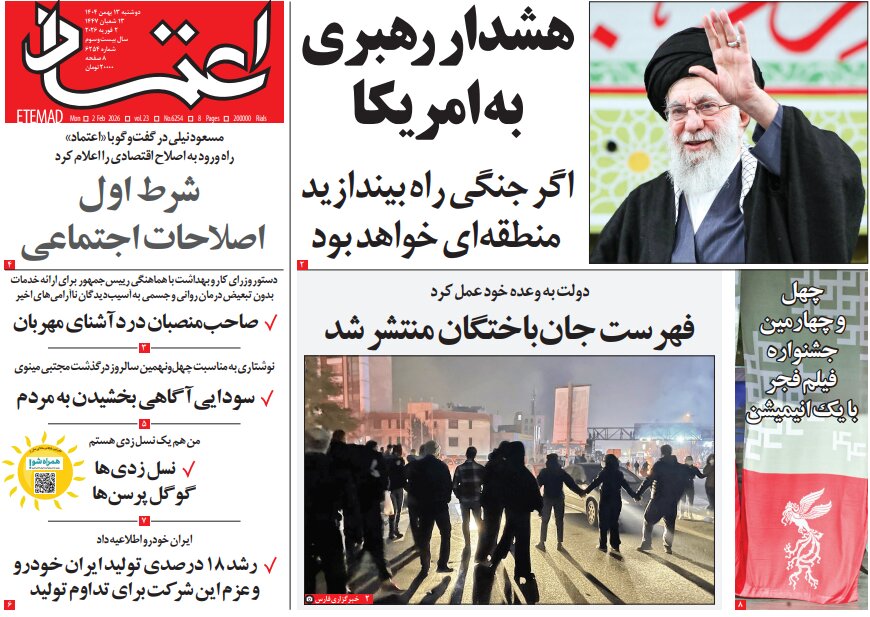
Trump is not a president seeking global order; he is an aggressive realist who aims to dismantle the existing order so that, in the ruins, his own power remains the only one standing. The deployment of the U.S. carrier, the USS Lincoln, is not meant for firing shots but to signal that if the opponent makes a mistake, the tables will be flipped. The carrier may create waves, but it cannot alter the course of history in the region. Tehran has shown a green light to diplomacy, yet its hand remains on the red button. Ultimately, it is economic resilience and security intelligence that will determine whether the Persian Gulf moves toward a grand understanding or a historic explosion.
Shargh: Active deterrence
Shargh analyzed recent regional developments, especially in the Persian Gulf. Iran has responded to the military posture of the USS Abraham Lincoln not with political statements but by rearranging its strategic assets. Iranian deterrence is no longer limited to missile launches; the scenario of a ‘great fire’ is on Tehran’s table. The atmosphere in Tehran is described as a blend of strategic patience and readiness for a counterstrike. While Western media report high-level defensive preparations, Iran’s official stance remains focused on dignified diplomacy. Meanwhile, the presence of the American aircraft carrier within range of Iran’s integrated drone–missile network effectively turns a military asset into a strategic hostage. Active deterrence means ensuring that Trump understands that if the trigger is pulled, the Persian Gulf will not become a battlefield but a logistical deadlock—one in which the price of oil becomes the first casualty in a powder?keg chess match. Iran’s response involves strengthening its nuclear and missile deterrence in hidden layers to signal that the cost of conflict for Washington would exceed anything the Pentagon imagines.
Farhikhtegan: The White House at a dilemma
Farhikhtegan argues that the White House has reached a decisive dilemma. The article says the United States must either take an action that Tehran has already described as the gateway to a full-blown conflict, or leave the scene without making any move. A retreat by Trump without any achievement to present to public opinion would place him under intense pressure and could weaken his other domestic and foreign policies. For this reason, the paper suggests that Trump may move toward striking an agreement to avoid reaching a dead end. Such an agreement would simultaneously allow him to escape political pressure and give him something to sell to the public. On the other side, Iran—having passed through the danger of confrontation—would return matters to the path of diplomacy in line with its core strategy. Still, Trump’s true intentions remain unclear, especially given the number of actors involved in this process.
Siasat-e-Rooz: Intensifying regional diplomacy reveals Iran’s real standing
According to Siasat-e-Rooz, the growing wave of regional and international diplomatic efforts to mediate between Iran and the United States is itself the clearest indicator of Iran’s true position. A country that is isolated, weak, or desperate for negotiation does not become the center of security and political consultations. That Iran welcomes mediation, especially by neighboring and regional states, is not a sign of weakness or fear. Rather, it reflects Tehran’s cooperative and responsible approach toward collective security. While Iran respects the views of friendly states and regional actors concerned with stability, its final decisions are based solely on national interests, sustainable security, and its non-negotiable rights. From this perspective, the formation of a negotiation structure does not represent a change in Iran’s behavior but the continuation of its strategic rationality—a rationality that balances active diplomacy with battlefield capability. The key point, the article warns, is that the greatest threat to the negotiation process is the other side’s misreading of Iran’s approach.
source: tehrantimes.com