The shocking death of the main antiIranian Zionist lobbyist
The shocking death of the main anti‑Iranian Zionist lobbyist
Hamshahri published an analysis clarifying the political character of Lindsey Graham, the Republican senator from South Carolina, in relation to Iran. According to Hamshahri, Graham’s death has left Zionist groups and anti‑government Iranian activists more grief‑stricken than anyone else, as he had been one of the most aggressively anti‑Iranian figures in Congress for nearly two decades and never hesitated to show hostility toward the Iranian people.
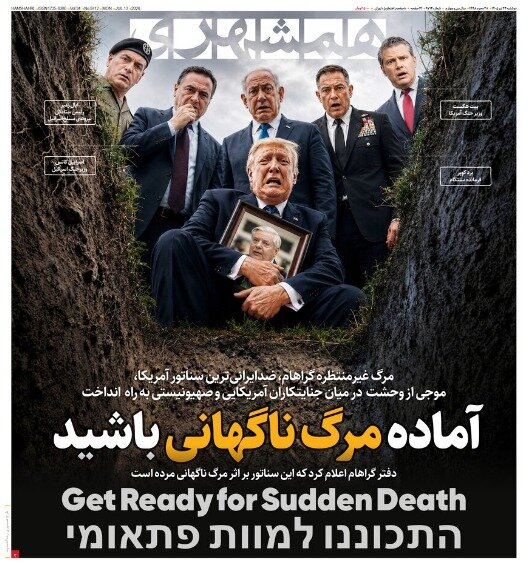
In recent years, he has been a staunch supporter of military action against Iran and has consistently pushed for harsher sanctions, increased political and economic pressure, and deeper security and military cooperation with Israel. In recent months, under the guise of “helping the Iranian people,” he advocated expanding the scope of military strikes against Iran. His death has shocked and saddened Zionist circles most of all, because he was considered one of the regime’s principal anti‑Iran lobbyists within the US governing structure for roughly the past twenty years.
Etemad: Negotiation is part of war
In an article, Etemad discussed the necessity of negotiations in the midst of conflict. According to the paper, at a time when the nuclear file, sanctions pressure, regional tensions, and the risk of military miscalculation simultaneously overshadow Iran’s foreign policy, the debate over negotiating with the United States has once again become a central point of political contention inside the country. Supporters of dialogue—representing a broad group of Iranians—argue that negotiation does not mean trusting Washington or normalizing relations or forgetting the blood of martyrs. Rather, it can serve as a tool to reduce the risk of war, manage crises, gain concessions, ease economic pressure, and prevent the formation of a full international consensus against Iran. In later stages, Iran could, through a durable agreement, achieve the strengthening of the Islamic Republic—an aspiration the martyred Leader considered fundamental.
Siasat-e-Rooz: Scattered clashes between Iran and the US
Siasat-e-Rooz dedicated its editorial to the causes of scattered clashes between Iran and the United States following the signing of the recent memorandum. The editorial states that the Americans attempted to create a passage for ships south of the Strait of Hormuz, within Oman’s waters, in violation of the agreement. Iran, exercising its legal rights, blocked the passage of vessels, and the Strait of Hormuz is now effectively closed under the authority of Iran’s armed forces. According to the paper, the limited clashes initiated by the US are intended not only to test Iran’s military capabilities in response to American attacks, but also to identify the locations and bases of Iran’s armed forces for potential large‑scale strikes at a later time. Senior Iranian commanders still view the situation as wartime and remain skeptical of diplomacy—though not opposed to it—because their presence on the ground gives them a clearer understanding of the realities.
Donya‑e‑Eqtesad: Saudi Arabia does not want its relations with Iran to deteriorate
Donya‑e‑Eqtesad analyzed the visit of a Saudi delegation to Tehran, writing that the visit challenges viewpoints claiming that regional relations with Iran are unrealistic and should move toward conflict and non‑cooperation. Escalating tensions in the Persian Gulf would dramatically increase the cost of regional crises. The paper argues that relations between Persian Gulf states and Iran can only advance through Saudi Arabia, the region’s major power. In recent years, Riyadh has sought to balance Iran, a strategy requiring a containment‑based approach. Countries that advocate heightened political confrontation with Iran lack the capacity for direct confrontation; therefore, balanced political solutions must be pursued. Today, Saudi Arabia prefers to engage Iran pragmatically, without tying this engagement to interpretations related to the outcomes or conditions of a war against Iran.
Ettelaat: How long can the “patience and threat” game continue?
Ettelaat examined the uncertain dynamic of patience and threat between Iran and the United States. The paper writes that neither Tehran can endure a prolonged economic limbo accompanied by new sanctions, nor can Trump—given his campaign promises to quickly resolve international crises—remain in a state of prolonged tension. This ambiguous situation can continue only until the deadline set in the memorandum. After that, only two scenarios remain: either Washington, recognizing Iran’s red lines (including arrangements in the Strait of Hormuz and halting new sanctions), takes a practical step to build trust and negotiations move toward a comprehensive agreement in Switzerland; or, if Trump insists on maximalist conditions and continues aggressive rhetoric, the memorandum collapses entirely. In the event of collapse, the region will likely enter a new phase of direct military and cyber confrontation, with consequences for financial markets and economic stability far more severe than before.
source: tehrantimes.com