Tehran Islamabad place emphasis on developing direct trade increasing trade exchanges
Tehran, Islamabad place emphasis on developing direct trade, increasing trade exchanges
TEHRAN- Imran Ahmed Siddiqui, Pakistan's Ambassador to Iran, and Mahmoud Najafi Arab, Head of the Tehran Chamber of Commerce, held a joint meeting with the presence of Hesameddin Hallaj, Deputy for International Affairs and Trade Development of the Tehran Chamber, Ayman Juwairiyah, Commercial and Investment Attaché of the Embassy of Pakistan in Iran, and Peyman Sanandaji, Head of the Transportation Committee of the Tehran Chamber.
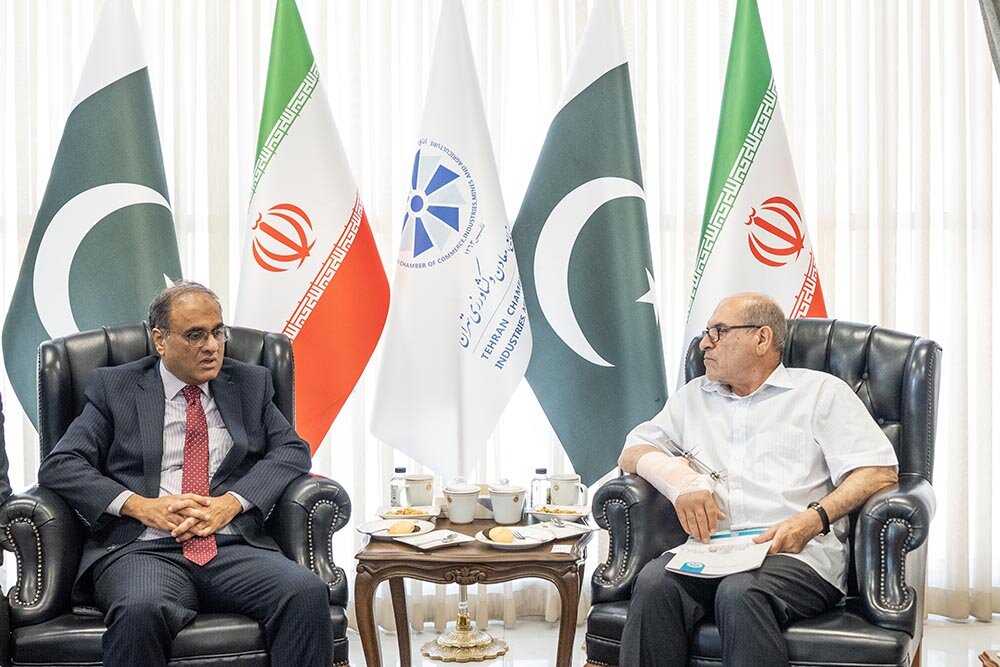
They discussed topics such as the development of economic cooperation between Iran and Pakistan, strengthening transportation infrastructure and border trade, facilitating customs procedures, and increasing joint investments.
Strengthening trade relations and increasing exchanges with focus on private sector
At the beginning of this meeting, Imran Ahmed Siddiqui, Pakistan's Ambassador to Tehran, referring to the capacities for cooperation between the two countries in areas such as food industries, pharmaceuticals, and agriculture, stated: "A portion of the exchanges that have so far been conducted through indirect routes can be carried out directly between the two countries, which will help reduce costs and develop economic cooperation."
He also emphasized the development of joint investments, the exchange of trade delegations, the active presence of Iranian companies in specialized exhibitions in Pakistan, and the strengthening of cooperation between the private sectors of the two countries. He considered chambers of commerce as one of the most important platforms for developing economic relations between Iran and Pakistan.
He added: "The presence of Iranian companies that are members of the Tehran Chamber in Pakistani exhibition events is a way to increase joint cooperation and ultimately build trust. Iranian economic activists in these exhibitions, in addition to expanding interactions with their counterparts in Pakistan, can also become familiar with the tastes of consumers in that country."
Strengthening border trade should be placed on agenda
In another part of this meeting, Mahmoud Najafi Arab, Head of the Tehran Chamber of Commerce, stating that "despite the long-standing cultural and trade relations between Iran and Pakistan, the volume of direct trade between the two countries is not favorable," emphasized: "In the current situation where restrictions have been created in the southern ports of the country, it is necessary to conduct trade directly and through the extensive common border of the two countries instead of indirect trade through other routes."
The Head of the Tehran Chamber also emphasized the importance of strengthening border trade and its role in the development of the economy of border residents and called for more effective utilization of this potential.
Najafi Arab noted: "Resolving the existing problems in border trade and providing the necessary facilities on both sides of the border will bring economic prosperity to border cities."
He also announced readiness for continuous interaction between the Tehran Chamber and the chambers of Karachi, Islamabad, and Lahore to improve trade activities and resolve logistical challenges, stating that chambers of commerce can play a more effective role in building mutual trust, providing accurate information to traders, and introducing economic opportunities of the two countries.
Support for free trade and tariff facilities
The Head of the Tehran Chamber continued his remarks by addressing the issue of free trade and the necessity of advancing dialogues in this area and added: "Any agreement between the two countries in the field of free trade can have positive effects on the volume of exchanges, reducing trade costs, and developing economic cooperation."
Najafi Arab, also referring to the importance of pursuing customs and tariff facilities and resolving banking and transportation issues as prerequisites for expanding bilateral trade, said: "With the development of currency exchanges, providing tariff and customs facilities, removing border bottlenecks, and pursuing the issue of free trade, we will witness an increase in imports and exports and, as a result, an improvement in the trade process between the two countries."
Examining transportation obstacles and accumulation of goods in Pakistani ports
Peyman Sanandaji, Head of the Transportation Committee of the Tehran Chamber, also in this meeting, referring to transportation problems and the accumulation of Iranian goods at Karachi port and other Pakistani ports, said: "Following the developments that have taken place in the region, numerous containers have been stopped at Pakistani ports, and a portion of these goods have faced additional costs." He added: "To accelerate the overland transfer of these containers, it is necessary to remove some obstacles and facilitate customs procedures."
The Pakistani Ambassador also announced his country's embassy's readiness to hold continuous meetings with the Tehran Chamber, follow up on trade issues, and inform economic activists about the latest trade regulations and requirements.
EF/MA
source: tehrantimes.com