From sacred spring to stone museum the long journey of Khusro IIs bust
From sacred spring to stone museum: the long journey of Khusro II's bust
Located north of Kermanshah, the Taq-e Bostan archaeological complex is renowned for its magnificent Sasanian rock reliefs and royal grottoes.
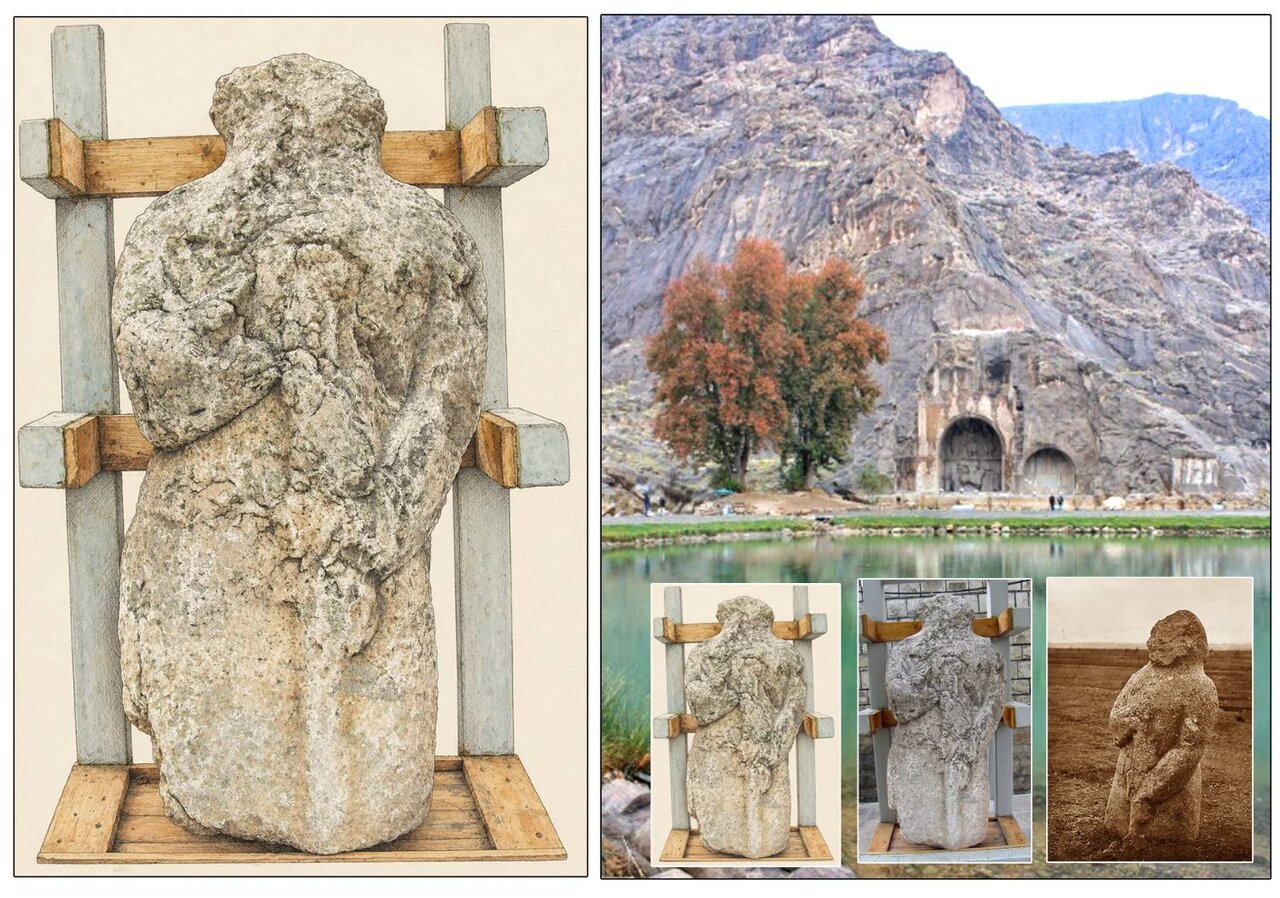
Among these celebrated carvings stands a lesser-known but equally significant artifact: a heavily damaged freestanding bust locally called Kol-e Jubor. This Kurdish toponym translates to "the short one who cuts the water stream" and is deeply rooted in regional agrarian folklore.
Local farmers traditionally attributed supernatural powers to the statue, blaming it for magically interrupting irrigation channels from the Kulehkehu River (Cham-e Bashir) whenever their fields ran dry, cementing its folkloric identity as an aquatic saboteur.
The bust is one of the few surviving examples of freestanding Sasanian sculpture, offering exceptional insight into the artistic and ideological expressions of the late empire. The most prominent parallel is the Colossal Statue of Shapur I, which stands in a limestone cave near Bishapur in southern Iran. Together, these two monuments constitute the only known major examples of Sasanian freestanding stone statuary.
The Kol-e Jubor's historical trajectory has been marked by severe instability and displacement. After being recorded by the 10th-century Arab historian Mis'ar bin al-Muhalhil (Abu Dolaf) in 341 AH, the statue toppled and remained submerged in the large karst spring before the grottoes for centuries. Western travelers Eugene Flandin (1840) and Annee Holt (1867) documented it lying in the water. By 1878, it had been extracted and propped up on dry ground, where it suffered extensive degradation from prolonged submersion and human vandalism, including gunfire that obliterated its facial features.
The statue's turbulent history is further illuminated by photographic and archaeological records. A modern image reveals a pockmarked, cracked, and heavily eroded stone torso, stripped of all facial features, currently secured within a gray metal frame and wooden clamps at the Taq-e Bostan Stone Museum. This condition is contextualized by early 20th-century documentation.
The renowned archaeologist Ernst Herzfeld photographed and recorded the statue, categorizing it within the "Sasanian Monuments" subseries of his papers. His handwritten notes explicitly identify it as a "Statue in round, Khusro II" (Taq-i Bustan: Carved in the Round Statue of Khusro II). This archival record, part of the Ernst Herzfeld Papers at the National Museum of Asian Art Archives, Smithsonian Institution, provides crucial evidence of the statue's early 20th-century state.
Despite the severe damage, the surviving torso preserves critical iconographic details. It highlights imposing, bulky shoulders and arms resting across the chest, along with a distinct vertical line of erosion indicating the placement of a sword vertically between the legs, against which the figure heavily leans. This configuration is interpreted as a deliberate symbolic allusion to military power and martial authority. The posture echoes the central investiture scene, while the attire matches Khusro's hunting reliefs. Facial reconstruction studies further indicate the king's characteristic short neck and broad visage, firmly aligning the bust with the monumental imperial effigy of Khusro II (Khosrow Parviz) and corroborating Herzfeld's identification.
Beyond royal portraiture, scholars have proposed a ritualistic interpretation, suggesting the grotto and statue collectively functioned as a tomb-sanctuary. In this framework, the lateral hunting and musical reliefs symbolize the preparation of sacred food and joyful entertainment meant to appease the Fravashi (royal guardian spirits) during the Zoroastrian Hamaspathmaedaya festival. The statue may therefore have embodied the sovereign's physical presence on earth, complementing the celestial representation of his investiture in the grotto.
In September 1818, Sir Robert Ker Porter recorded carved pairs of feet attached at the ankle on the flat plateau above the large arches.
Subsequent field surveys confirmed these remnants at the end of the sculpted staircases on the eastern side, indicating this elevated platform as the statue's original pedestal. Likely toppled from this height due to iconoclastic violence, the statue fractured severely. Consequently, recent research proposes that the fragmented torso undergo careful restoration and be re-erected at its original location atop the arches, allowing the Kol-e Jubor to once again preside over the sacred springs of Taq-e Bostan.
AM
source: tehrantimes.com