Upcoming precipitation expected to help revive Hour alAzim wetland
Upcoming precipitation expected to help revive Hour al-Azim wetland
TEHRAN – Increased rainfall forecast for the coming two seasons is expected to help restore the Hour al-Azim wetland, Ahmad-Reza Lahijanzadeh, the deputy head of the Department of Environment (DOE), has said.
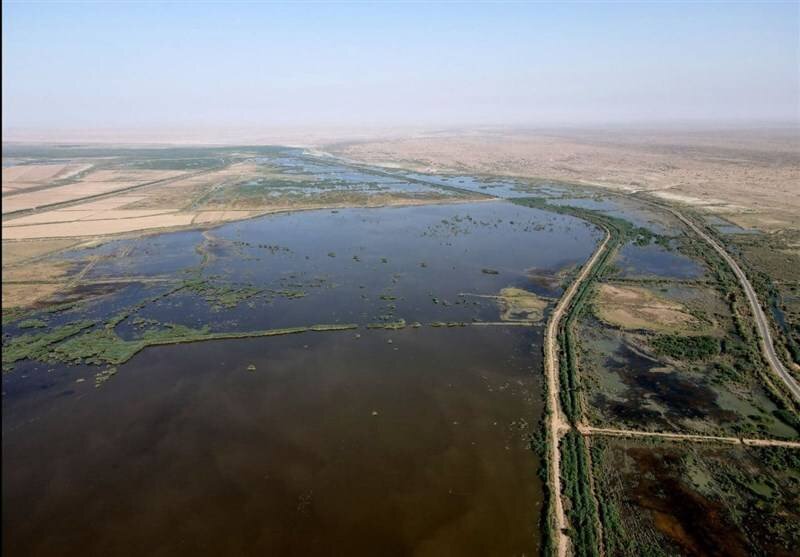
Located in the southwestern province of Khuzestan, on the border of Iran and Iraq, the wetland is part of the Mesopotamian marshes and is known as one of the region’s valuable ecosystems. The wetland serves as an important wintering and breeding habitat for migratory birds.
It also plays a crucial role in managing dust, moderating the environment, and creating a shield against extreme weather events in the region, Mehr news agency quoted Lahijanzadeh as saying.
The wetland is primarily fed by Karkheh River in Iran and the Tigris in Iraq. Over the previous water year (September 23, 2024 – September 23, 2025), it grappled with a severe lack of water due to a drastic reduction in water inflow to the Iraqi section, which dried up the wetland and led to spontaneous combustion, releasing a large amount of air pollution and smoke, adversely affecting cities in Khuzestan province, the official highlighted.
In the current water year (September 23, 2025 – September 23, 2026), the increase in precipitation in the last month of winter and the first month of spring helped part of the wetland to be filled with water, which has significantly dropped due to a lack of water in summer, Lahijanzadeh added.
The constant inflow of water, the provision of the wetland’s water rights, and transboundary cooperation are among key factors to preserve the ecological function of the wetland and prevent it from turning into a dust hotspot and fuel for wildfire, the official further noted.
With the El Niño phase developing across the Pacific Ocean, the country is forecast to receive considerable rain in the fall and winter.
‘El Niño’ or “the boy” is widely used to describe the warming of sea surface temperature that occurs every few years, typically concentrated in the central-east equatorial Pacific.
Rainfall, restoration projects replenish many wetlands
In spring, heavy rainfall, along with restoration projects, increased water flow into many wetlands, including Shimbar, Zarivar, Helleh, and Hour al-Azim, bringing them back to life.
“Thanks to a 3.7 percent increase in average rainfall, the water inflow to wetlands across the country has improved compared to last year,” IRIB quoted Arezou Ashrafizadeh, an official with DOE, as saying
In Gilan province, Bojaq wetland was in good standing. Anzali wetland was in fair condition after the removal of invasive water hyacinths. However, Gorgan Bay, and Miankaleh wetland required additional measures to be restored. Sadly, in Golestan province, Alagol wetland was not in a favorable condition due to low rainfall, the official noted.
About 70 percent of Quri Gol wetland, the only fresh wetland, in East Azarbaijan, was filled with water. Compared to the same period last year, the water level of the wetland increased by 27 cm, reaching 1912.43 meters.
Some 116 hectares of the wetland were filled with water. It had about 700 million cubic meters (mcm) of water, which was lower than the 3.8 mcm amount designated for the wetland.
Quri Gol wetland hosts over 92 bird species, which are all migratory birds, except redhead coots, 14 species of reptiles, 4 species of amphibians, and one species of fish, as well as 280 plant species.
In Fars province, 80, 30, and 10-15 percent of Maharloo, Arjan, and Bakhtegan wetlands were filled with water.
With an area of 600 sq. Km, Maharloo Lake in southern Fars Province is a perfect stopover for migratory birds, including flamingos. In mid-summer, the lake loses its water due to high evaporation, leaving behind a white bed and pinkish-colored water.
The Arjan restoration project is in the beginning phase; it covers 2000 hectares. The water of the wetland depends on the amount of rainfall. The wetland is one of the main habitats for migratory birds like cranes, flamingos, wild ducks, and geese.
Bakhtegan is a Salt Lake with a surface area of 3,500 square kilometers, once Iran’s second-largest lake. Several dams on the river had significantly reduced water flow into the lake, increasing its salinity and endangering the lake’s populations of flamingos and other migratory birds.
Bamdej wetland is being revived. The project to restore the wetland kicked off about two years ago with the help of the private sector, investing 1.3 trillion rials (around 8 million dollars), with 2 trillion rials (about 12 million dollars) more which is needed to complete the project.
Intense rainfalls led Shimbar, Zarivar, and Helleh wetlands to be filled to 100 percent and overflow.
Located at the foot of the Zagros mountains, Zarivar is a freshwater wetland designated as a Ramsar Site.
Marreh wetland in Qom province was in a favorable condition. Known as the “Desert Gem”, the wetland stands as one of the five significant wetlands in Qom province, becoming a sanctuary for various bird species.
Sprawled about 40 kilometers north of the city of Qom and adjacent to the Qom – Tehran highway, Hoz-e-Sultan wetland, a salt lake, is struggling with water scarcity.
Miqan wetland, in Markazi province, also revived after years of drought. The wetland’s 12,000-hectare water body was restored following years of drought, thanks to favorable rainfall.
The last time more than 100 million cubic meters of water entered the wetland was in 2019, when the entire basin became submerged, Press TV reported.
Miqan Wetland hosts around 12,000 migratory birds annually, including species arriving from Siberia. More than 16 percent of Iran’s bird species and 60 percent of the bird species recorded in Markazi province inhabit the wetland.
Spanning over 927 hectares, Kani Barazan wetland, which is one of the most important satellite wetlands south of Lake Urmia, was also recovered.
MT/MG
source: tehrantimes.com