IRCS holds advanced life support course for Ghanaian health staff
IRCS holds advanced life support course for Ghanaian health staff
TEHRAN – The Iranian Red Crescent Society’s health center in Ghana has held the first advanced life support course for nurses in the African country, aimed at strengthening their capacity to respond effectively to medical emergencies.
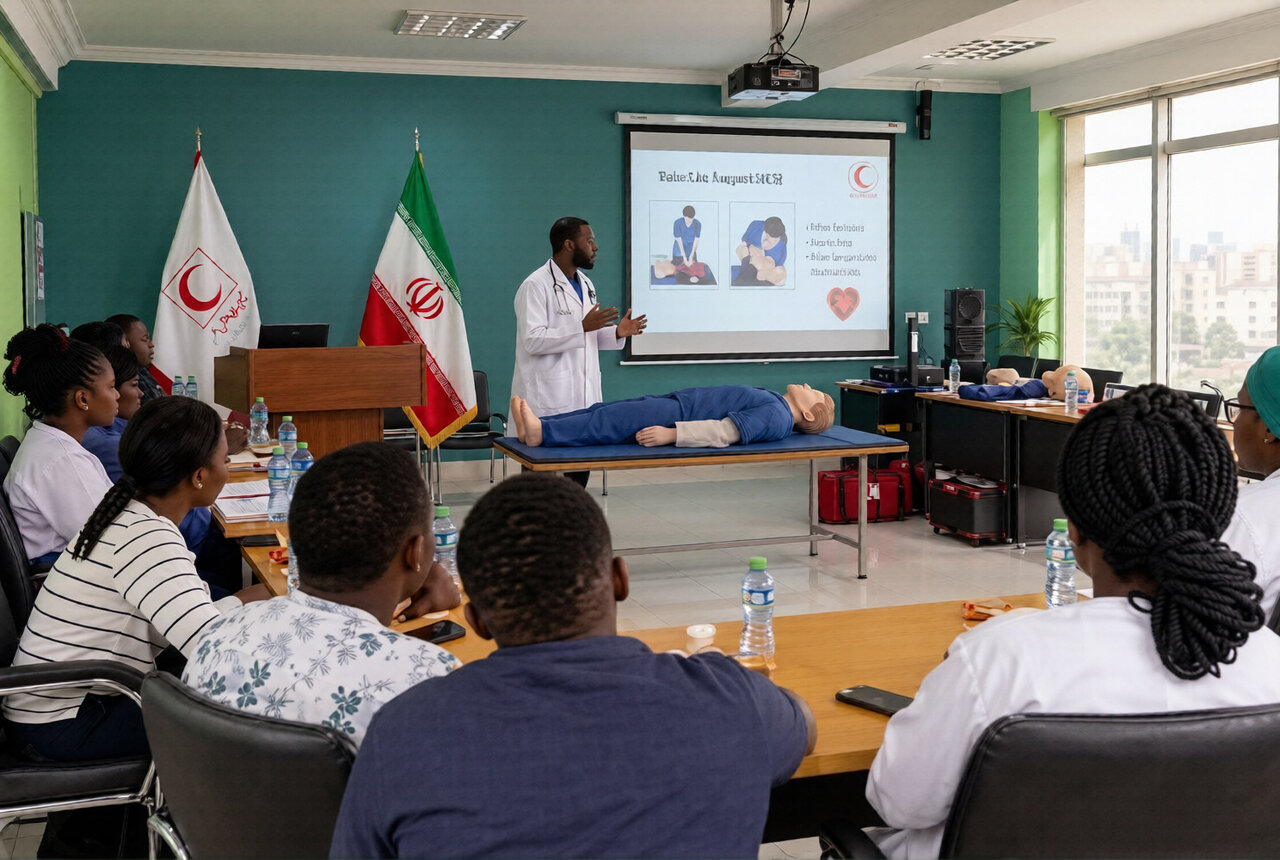
In addition to providing medical services, the center seeks to boost educational infrastructure and improve the knowledge of the health staff through sharing expertise with them, the IRCS website reported.
The IRCS is also holding an online training program and a practical training workshop at the center to ensure the specialized training will be ongoing so that the health personnel fully benefit from the IRCS capacity and knowledge.
The initiative does not merely target health staff; it also plans to train the local community. The program focuses on first aid training and essential rescue skills to prepare individuals for unexpected emergencies and teach them how to handle the situations and respond effectively to a wide range of injuries. In case of an emergency, the trained person can help the wounded people in the first critical seconds prior to the arrival of medical teams.
Health services in Ghana
In August, the IRCS health center in Ghana organized a one-day medical camp aimed to provide free medical services to flood victims and the needy, benefiting 547 individuals.
The initiative was taken following floods in the city of Accra and a request from the Ministry of the Ministry of Inner City and Zongo Development. IRNA quoted Hamidreza Dehqan, an IRCS official, as saying.
The Iranian Red Crescent Society’s health center was deployed to provide free medical care to those seeking assistance and individuals in need, Dehqan added.
He noted that 547 people benefited from health services during the one-day medical mission. The services provided included general practitioner consultations, medication distribution, pharmacy services, mobile laboratory testing, and counseling on midwifery and hygiene.
The humanitarian activities of the IRCS are not confined by geographical boundaries, Dehqan said, adding: “The presence of the Iranian Red Crescent Society’s health centers in various countries exemplifies the organization’s humanitarian approach to addressing the needs of local communities—an approach that prioritizes human dignity, assistance to the needy, and the alleviation of human suffering.”
In such programs, providing free medical services to those in need exemplifies altruism and humanitarian responsibility, demonstrating that serving humanity—transcending geographical boundaries—is one of the Iranian Red Crescent Society’s most vital missions, Dehqan stressed.
Referring to the fundamental principles of the International Red Cross and Red Crescent Movement, he noted that humanity, impartiality, neutrality, independence, voluntary service, unity, and universality constitute seven fundamental principles; the implementation of health programs in underdeveloped areas represents the practical manifestation of these principles in the field of service.
He emphasized that a key approach of the Iranian Red Crescent Society in its overseas operations is to simultaneously focus on treatment, prevention, and the promotion of community health.
“In this context, organizing health camps—alongside the ongoing activities of Red Crescent health centers—facilitates access to medical and counseling services for vulnerable groups.”
Pointing to the operations of the Iranian Red Crescent Society’s health center in Ghana, Dehqan stated that the continued presence of IRCS health centers in African nations is part of the Society’s humanitarian mission on the international stage, a presence founded on serving humanity and helping to improve the health of local communities.
MT/MG
source: tehrantimes.com