Tehran Doha explore partnership opportunities in ICT sector
Tehran, Doha explore partnership opportunities in ICT sector
TEHRAN – Information and Communication Technology (ICT) Minister Sattar Hashemi and Qatar’s ambassador in Iran Saad bin Abdullah Al-Mohammad Al-Sharif have underlined the need to expand cooperation between the two countries in the ICT sector.
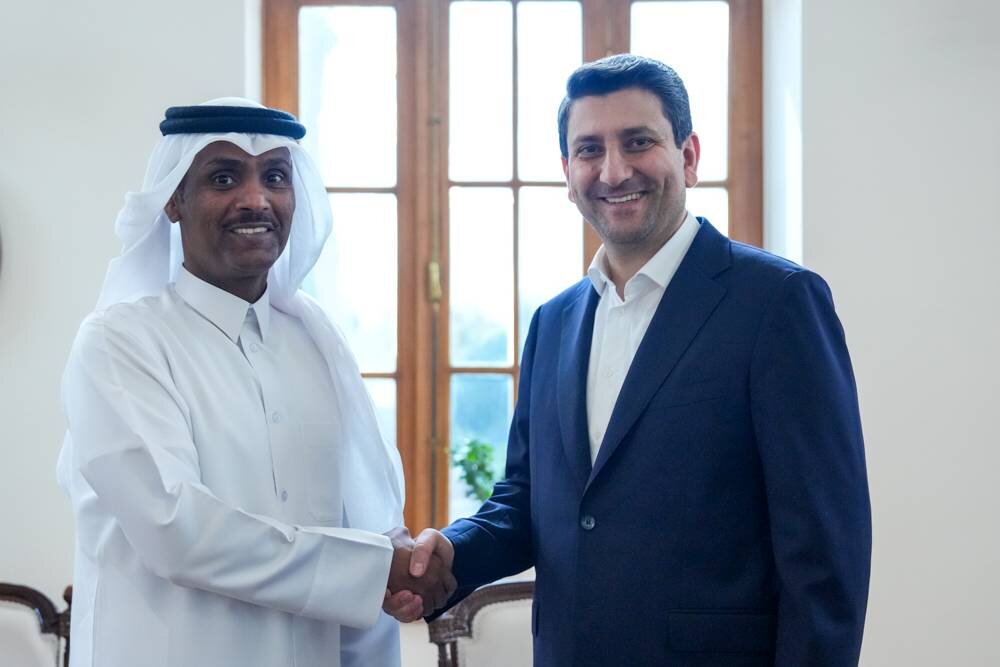
The officials met in Tehran on Wednesday, discussing ways to develop joint efforts in the field of ICT, particularly digital technologies, Mehr news agency reported.
The talk also focused on Iran and Qatar collaborations in international organizations and specialized forums, including the interaction of the two nations within the International Telecommunication Union (ITU) and the ITU Plenipotentiary Conference.
Regarding the role of ITU in shaping global policies and standards within the ICT sector, coordination and interaction among member states can provide a favorable basis for pursuing shared perspectives and interests, as well as strengthening international cooperation.
The next ITU Plenipotentiary Conference (PP-26) is set to take place from November 9 to 27 November in Doha, Qatar. Held every four years, the conference brings together member states to make decisions on strategic and financial direction, future activities, elect leadership, and adopt resolutions that shape global telecommunications and Internet policy for the next four years.
Expanding ICT ties with neighboring nations on the agenda
On the sidelines of the first session of the UN Global Dialogue on AI Governance, convened by the UN General Assembly in Geneva on July 6 and 7, the head of the Information Technology Organization of Iran, Mohammad-Mohsen Sadr, has held separate meetings with Iraqi, Pakistani, and Omani officials to discuss ways to enhance collaboration between Iran and these countries in the ICT sector.
Holding a meeting with Iraqi Minister of Communications Mustafa Jabbar Sanad, the two sides highlighted the role of information technology and artificial intelligence in helping to address energy imbalances, developing smart infrastructure, enhancing productivity in the energy sector, and fostering cooperation in e-government and data transit. They also discussed expanding cooperation in digital transformation, exchanging technical expertise, and implementing joint projects.
The Iranian official met Shaza Fatima Khawaja, the Pakistani Minister for IT and Telecommunications, as well. During the meeting, both parties explored avenues to enhance cooperation between Iran and Pakistan in the fields of information technology, e-government, artificial intelligence, digital economy, cybersecurity, and the development of the innovation ecosystem.
In his X account, Sadr described the meeting with the Omani official as a constructive one, which particularly focused on e-government, artificial intelligence, digital economy, communication infrastructure, and expanding technological interactions between the two countries.
The two countries have high capacities to deepen digital cooperation and develop joint initiatives in the future of the digital economy, he added.
AI governance is the set of rules, standards, and oversight practices that determine how artificial intelligence systems are built, deployed, and held accountable, and in July 2026, it moved onto the world stage.
The official said a workshop on Artificial Intelligence and the Government Digital Ecosystem held on July 7 at the International Telecommunication Union (ITU) headquarters in Geneva was very well received by the participants; it included his speech and the talks of other representatives from UNDESA’s E-Government Assessment Branch and the ITU Development Sector, as well as university professors.
The UN Global Dialogue on AI Governance was the world’s first intergovernmental platform where every government and stakeholder group sat at the same table to align on AI oversight.
It is a direct product of the Global Digital Compact, the digital cooperation framework adopted in September 2024.
The Dialogue brought together all 193 UN member states alongside the private sector, civil society, academia, and the technical community. It received the first annual report of the UN Independent International Scientific Panel on Artificial Intelligence, giving member states a shared evidence base.
Crucially, the forum adopts no binding resolutions or regulations. It is a place to exchange best practices and build common approaches, and it ran alongside the World Summit on the Information Society (WSIS) Forum 2026 and the International Telecommunication Union (ITU) AI for Good Global Summit in the same week. A second session is scheduled for New York in May 2027.
MT/MG
source: tehrantimes.com