Territory before politics Why Trump cannot neutralize Hezbollah
Territory before politics: Why Trump cannot neutralize Hezbollah
TEHRAN – During Lebanese President Joseph Aoun’s White House meeting with his U.S. counterpart, Trump again publicly promoted the idea of Syrian forces confronting Hezbollah.
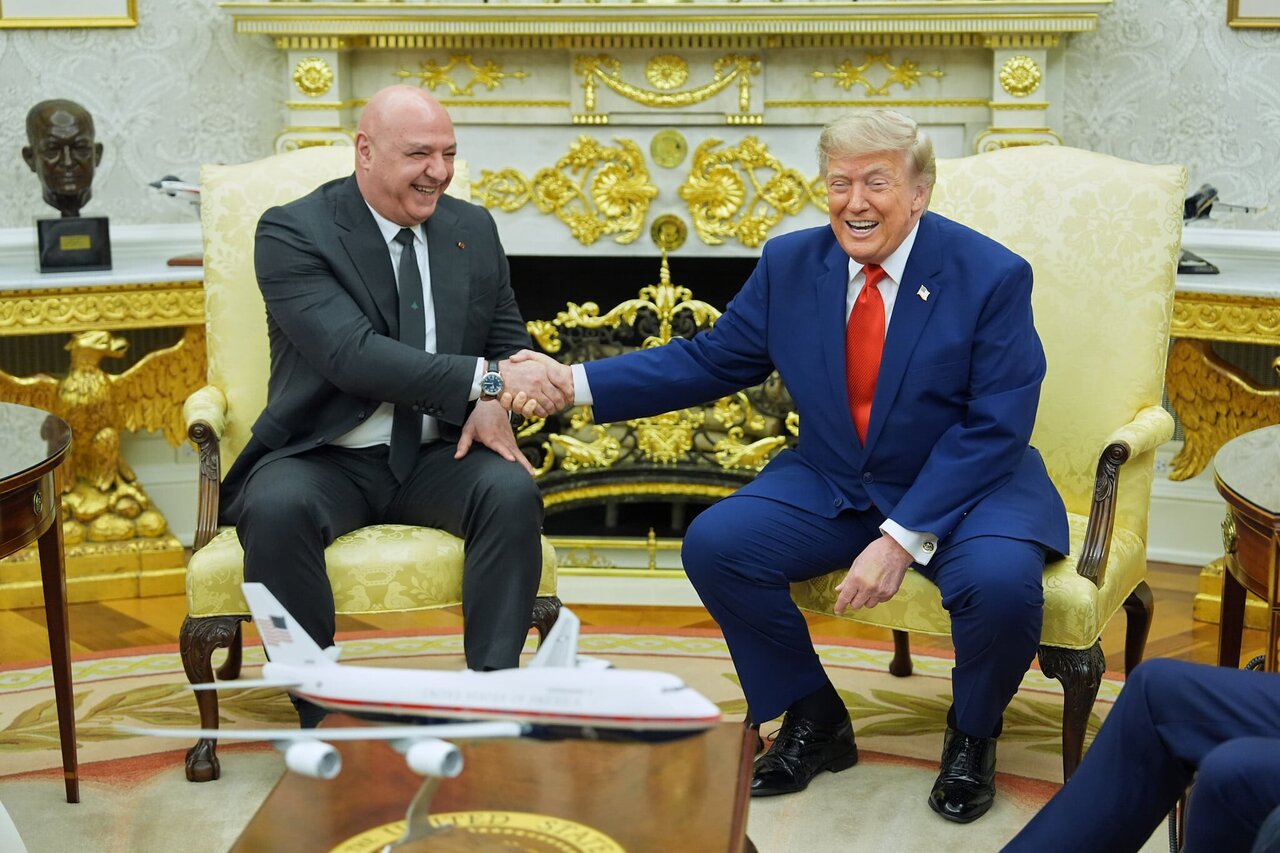
Where the Israeli Occupation Forces (IOF) failed to achieve their objectives in southern Lebanon, Trump said Syria’s self-proclaimed President Ahmed al-Sharee “would like to come in and do something with Hezbollah.”
“He has been fighting Hezbollah for a long time. I think it would be very effective,” Trump added. Aoun did not address the U.S. proposal of Syrian militants entering Lebanon to the media, nor did he say anything to Trump.
Hezbollah fought Jolani, then a commander of the al-Qaeda affiliated Nusra Front in Syria, to prevent the terrorist group and others from crossing into Lebanese territory. Hezbollah did so successfully across the Lebanese-Syrian border. However, at least one terrorist managed to detonate his explosives inside southern Lebanon, killing civilians.
Aoun told Trump that “the ultimate goal is to end the state of hostility between Lebanon and Israel forever. The time has come to realize President Trump’s vision that peace should prevail throughout the region.”
Lebanon’s President explained that he had asked Trump for “political support,” in addition to continued support for the Lebanese Army, which he described as the country’s “most trusted institution.”
Critics say Lebanon’s “most trusted institution” has long functioned as little more than a police force and will continue to do so, lacking both the military capability and the political will to halt Israeli aggression, which continued even after the meeting concluded.
The IOF carried out an explosion in the vicinity of the town of Baraachit in the Bint Jbeil district. The IOF also launched two airstrikes by fighter jets on the area between the towns of Mansouri and Majdal Zoun in the Tyre district.
As part of the ongoing aggression, an IOF drone dropped a stun grenade over Mansouri. The IOF carried out a large explosion in the town of Kfartebnit, the blast of which echoed across the Nabatieh area.
Lebanon’s emergency operations center of the ministry of public health said in its latest statement issued so far that the cumulative toll from the expanded aggression between 2 March and 20 July has risen to 4,328 dead and 12,230 wounded.
Critics also accuse President Aoun of falling into a U.S.-orchestrated trap. Washington’s strategy extends beyond preserving Israel’s occupation of Lebanon and Hezbollah’s disarmament. They argue it also seeks to exploit southern Lebanese territory by offering economic assistance contingent on political and security concessions that will not change anything on the ground.
The war in Lebanon is governed by the value of geographic territory and its ability to generate the power of resistance for Hezbollah. The current negotiations and economic initiatives serve as tools to reshape this territory and dismantle its sources of strength.
Whenever war erupts in southern Lebanon, analysts turn their attention to politicians’ statements, the outcomes of negotiations, and the positions of regional and international powers, as though politics creates geography. Yet the reality is sometimes the exact opposite: geography creates politics, compelling states and rival forces to reproduce the same conflict, even if its tools and participants change.
Any attempt to understand southern Lebanon through politics alone inevitably produces an incomplete explanation, because politics changes while territory remains the most enduring element of the war. It is this permanence that causes interests to recur and conflicts to renew themselves, even as governments change and alliances are reshaped.
The real question, therefore, is this: why does this territory return, generation after generation, to the center of conflict in the region, regardless of how the balance of power shifts?
What is meant by territory here is not simply a geographic area or borders drawn on a map. It is the geographic environment whose natural, economic, demographic, and even civilizational characteristics impose limits on political actors. Over the long term, political behavior becomes a reflection of the struggle over territory more than the product of governments’ decisions alone.
If territory is what draws the limits of political movement, then southern Lebanon represents one of the clearest examples of this in the Arab world.
Its importance stems not only from being part of Lebanese territory, but from its position at the intersection of several strategic regions simultaneously. It overlooks the Upper Galilee in occupied Palestine, is naturally connected to the Syrian hinterland through the Beqaa Valley, faces the eastern Mediterranean coast, and contains water resources and natural corridors that have given the region, throughout history, an importance far exceeding its geographic size.
The value of southern Lebanese territory lies not only in its geographic location, but also in its capacity to accumulate the elements of power. A territory that provides strategic depth, communication routes, natural resources, and a cohesive population does not merely grant a temporary advantage to any political actor; it enables the gradual construction of power that grows stronger over time.
The population of southern Lebanon offers a supportive social base (that overwhelmingly favors Hezbollah), while natural and economic resources sustain long-term endurance.
Applying this principle of territory and accumulation to Lebanon makes it easy to understand why the region stretching from southern Lebanon to Baalbek and Hermel is more than an area with a Shia majority. It constitutes an interconnected geographic space that, whenever freedom of movement exists within it, allows military, logistical, and human capabilities to accumulate in ways that make any force based there more resilient, better able to regenerate its capabilities, and increasingly capable of expanding its influence over time.
Hezbollah’s social base ensures continuity, geographic depth provides protection, communication networks guarantee mobility, while local resources and capabilities transform this interconnectedness into power that steadily accumulates over time.
As long as the Zionist regime remains in the occupied Palestinian territory and the occupied Golan, it will continue seeking to occupy southern Lebanon and annex it to its territory.
This is why it is difficult to understand the Lebanese government’s current drive toward negotiations with the Zionist regime as an attempt to secure a ceasefire or resolve a border dispute without taking bad faith into account.
Any political or security arrangements that reduce freedom of movement within this space or sever the geographic connection between southern Lebanon and its natural hinterland in the Beqaa Valley will directly weaken Hezbollah’s ability to preserve and regenerate the accumulated elements of its strength.
The Lebanese government, like all other parties, understands that no political agreement can alter the realities imposed by the geography of southern Lebanon. Nor will the signing of an agreement eliminate Hezbollah or transform the environment in which it emerged.
The success of the Lebanese government’s strategy ultimately depends on whether regional and international powers can alter the realities imposed by geography and history, an objective that appears difficult to achieve given the breadth and interconnectedness of the conflict zones stretching from southern Lebanon to Iraq, the Red Sea, and the Persian Gulf.
The core of Lebanon's present crisis does not just lie in the absence of the so-called agreements with the Zionist regime, but in the impossibility of changing the territory that produced the resistance and made it the cornerstone of the regional conflict.
Developments so far show that the Lebanese government’s efforts to reshape the south continue to collide with the resilience of the resistance axis and its ability to obstruct the transformations being pursued.
The emerging order in the region will not be determined at negotiating tables, but by the balance of power imposed by geography and by the struggle over territory.
source: tehrantimes.com