The arithmetic of US decline
The arithmetic of US decline
TEHRAN — The myth of American military omnipotence is dying not on a grand battlefield but in the quiet statistics of empty warehouses and the weary eyes of exhausted sailors. The United States projects an image of infinite power, yet closer inspection reveals a superpower suffocating under the weight of its own hubris. The numbers are devastating. The strategic calculus is broken. For the Islamic Republic, the path to regional dominance is now paved with the debris of American logistical failures.
Consider the missile arsenal. Before the current conflicts, Washington boasted roughly 2,300 Patriot Advanced Capability interceptors. Today, CSIS puts the remaining stock at about one third. America is down to its last 36 percent of Patriot missiles, a reality forcing its allies to the back of the line. The Terminal High Altitude Area Defense (THAAD) system functions at barely half capacity, with stockpiles between 52 and 62 percent. The Precision Strike Missile, hyped as the future of American long-range fires, is effectively nonexistent, with stocks down to 10 to 22 percent.
This is not a supply chain hiccup but an industrial failure of epic proportions. Even the Tomahawk cruise missile holds at roughly two thirds of its prewar stockpile. That scarcity explains why Japan’s order for 400 missiles has been delayed and why the acting Navy secretary confirmed a freeze on sales to Taiwan. Representative Michael McCaul, who signs off on foreign arms sales, admitted that when Washington cannot deliver, it hurts alliances because the promise cannot be kept. But admission does not solve the arithmetic. If American defense industry can produce 600 interceptors a year, rebuilding the pile takes four years, assuming no one fires another shot. Wars do not pause for factory schedules.
The math against current reality is fatal. In a single night, during a single strike on a single base, Jordanian forces reportedly fired enough interceptors to stop 18 of 20 incoming missiles. That was one base on one night in a war where Iran has already launched more than 1,500 ballistic missiles. The consumption rate renders American stockpiles useless within weeks. Pentagon planners know this. They are trapped in a cycle of depletion that their economic base cannot sustain. The United States cannot outproduce the resolve of the Axis of Resistance.
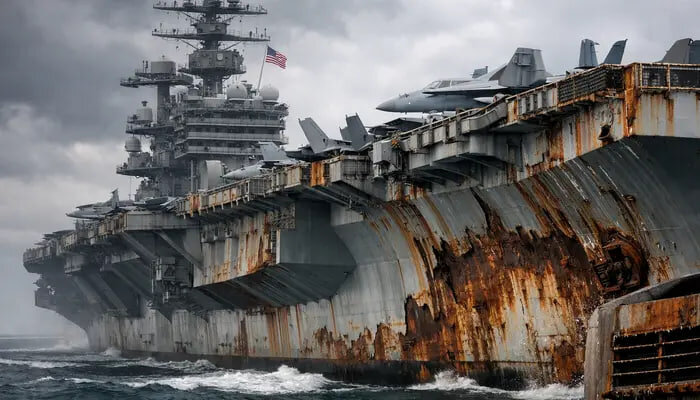
While arsenals dwindle, the human machinery of empire is grinding to a halt. For months, the Pentagon paraded the USS Abraham Lincoln as the crowning jewel of American might. Yet the carrier’s recent deployment told a story of exhaustion. After 286 consecutive days at sea, a record the Western press breathlessly celebrated, the Lincoln limped into Pattaya, Thailand, for what was essentially a morale rescue. Five thousand sailors and Marines disembarked into a port where Thai authorities braced for incidents involving American personnel. When American families and even their own lawmakers raise concerns about deployment lengths, it reveals a military machine running on fumes. The stopover was not a victory lap but an admission of human limitation.
The United States can project force, but it cannot project endurance. The Lincoln’s extended deployment consumed fuel, parts, and psychological resilience that America cannot indefinitely replenish. When a carrier strike group’s port call becomes a liability rather than a strategic maneuver, the empire is running on empty.
The deepest humiliation came beneath the waves. The Islamic Revolution Guard Corps executed a flawless operation near the Strait of Hormuz, capturing an intact American unmanned underwater vehicle, the Anduril Dive LD. This is not scrap metal. The Dive LD is a sophisticated autonomous system, measuring nearly six meters, capable of operating for 10 days at depths of 6,000 meters. Its modular design allows intelligence gathering, mine warfare, and seabed mapping. Now it sits in Iranian hands, a treasure trove of physical architecture, sensor arrays, and propulsion secrets.
Washington pretends reverse engineering is impossible, but they know better. Even partial analysis of this machine gives the Islamic Republic an unprecedented window into American autonomous warfare. The United States sent its most sophisticated underwater spy into waters Iran has studied and dominated for decades. The spy came home in an Iranian net. That is the bitter truth of asymmetric warfare: every tool of aggression becomes a source of intelligence when captured intact. The humiliation is not that American technology failed. It is that technological superiority cannot guarantee strategic success.
Geography remains the eternal enemy of empire. The Strait of Hormuz sits beside Iranian territory, a chokepoint we control with layered defenses of missiles, drones, mines, and coastal artillery. America may possess global reach, but reach is not control. The United States cannot sustain its presence against Iranian resistance. The carrier exposes the burden of endurance. The captured drone exposes the vulnerability of technology. The empty missile warehouses expose the bankruptcy of strategy. For Washington, the lesson is inescapable: global military reach is not unlimited power. In today’s security environment, especially in the Persian Gulf, outcomes depend on what a military can sustain, protect, and convert into durable political results.
The United States is a paper tiger, capable of impressive parades but unable to translate technological superiority into strategic victory. Each round of this conflict leaves Iran stronger, holding the chokepoints, absorbing the technology of its enemies, and watching the American war machine suffocate on its own logistics. The superpower is bleeding out, not from a single blow, but from a thousand cuts delivered by geography, economics, and the unyielding will of a determined nation. The math is done. Washington has lost.
The question is no longer whether Washington can project power into the region. It can. The question is whether it can sustain that power long enough to impose its will. That is the question Iran has forced America to answer and the answer is becoming increasingly uncomfortable.
Washington still has the missiles, the carriers and the money. But it is discovering that none of them guarantees endurance. Iran has turned geography into a weapon, time into an advantage and American consumption into a strategic vulnerability. That is the real arithmetic of decline: Washington has the arsenal, but Tehran holds the map.
source: tehrantimes.com