Why is Europe on fire this October
Why is Europe on fire this October?
TEHRAN — It started with teenagers blockading their schools. Three weeks later (October 17), about 550,000 people marched through French towns and cities, according to Interior Minister Laurent Nuñez. Unions say 800,000.
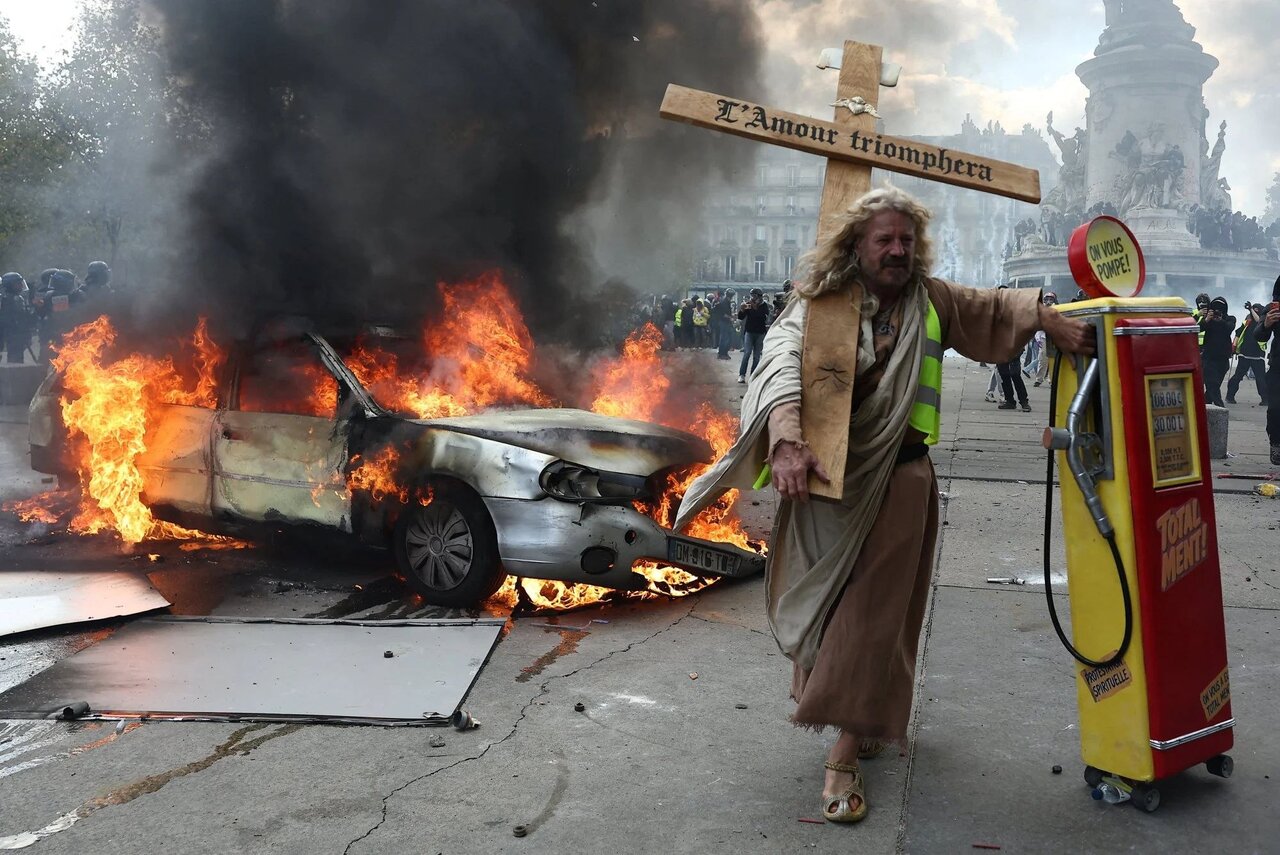
Crowds followed in Milan, Lisbon, Madrid, Brussels and Tirana, and several marches ended in fires, looting and tear gas.
Though the triggers differ from capital to capital, the bill is the same everywhere: more for diesel, food and rent, less from the public services people already pay for.
Behind it sits a war that European governments say they were never consulted on, launched by Washington and Tel Aviv on February 28.
A bill Europe cannot dodge
Traffic through the Strait of Hormuz, which normally used to carry about a fifth of the world's oil and liquefied natural gas, was effectively shut after the attack on Iran.
Energy infrastructure became a front line. American-Israeli strikes hit Iran's Pars energy zone in Asaluyeh, a hub for processing gas from the world's largest gas field. Iran's retaliation forced Qatar to halt LNG production. Brent crude climbed above $100 a barrel.
Europe, whose gas market was already very tight after a cold winter, has been paying for a war it did not start and cannot end.
The European Commission puts the cost to Europe at roughly €100 billion in disrupted trade and energy markets. In some areas, gas has climbed about 140 percent and diesel has doubled.
On October 6, Commission President Ursula von der Leyen said imported fossil fuels had cost Europe an extra €100 billion "without a single molecule of additional energy."
EU gas storage sits near 70 percent, well under the usual 80 for this time of year, and Germany's tanks are about half full.
Brussels now asks member states to limit heating in public buildings and switch off unneeded street lighting. TotalEnergies, meanwhile, has reported a surge in quarterly profit.
Despite ample evidence of their complicity, European leaders insist that the war is not theirs. Chancellor Friedrich Merz claims Washington consulted no one and has “no convincing plan.”
Polls show about 58 percent of Germans call the campaign of aggression against Iran unjustified and 68 percent of Spaniards oppose the war.
The invoice arrives regardless. The same reckless hegemon that started the war has imposed a 15 percent tariff on most EU goods, a deal Paris called a "submission," while it plans to buy Russian diesel itself while EU states fail to agree on relief.
Europeans are trapped in the orbit of a so-called ally that picks the wars and mails the receipts.
However, analysts warn against a single-cause story. Years of lagging wages and pandemic debt have left households without a cushion, so every new shock lands on bare ground.
A school blockade becomes a national crisis
The French movement began in late September, when high school students in working-class Paris suburbs blockaded schools over teacher shortages, crumbling buildings and lessons lost whenever absent staff go unreplaced.
The CGT union joined while the students were on fall break, then farmers, transport workers and public employees.
By mid-October, the unrest had escalated dramatically, culminating in about 2,400 arrests and hundreds of injuries, with shops looted in Paris, Marseille, Lyon and Bordeaux and Limoges’s 19th-century city hall nearly destroyed.
President Emmanuel Macron, in a rare televised address, acknowledged protesters' "legitimate demands" but blamed "far-left activists" for the destruction. He also described the Iran war as one of the main causes of economic hardship in France.
His government has already promised 3,000 substitute teachers and dropped planned university fee increases, an admission that the grievances are real.
Iran’s Foreign Minister Abbas Araghchi said in a post on X that Macron had “made his bed” by assuring Trump that he welcomed atrocities against Iranians. “Too late to blame the war his ilk helped cause,” Araghchi added.
The numbers explain the mood. Unemployment is 8.3 percent, and 21.6 percent among those aged 15 to 24. Consumer prices rose 3.1 percent in September, with energy up 21.3 percent.
Economists estimate a family of four has lost about €1,200 a year in purchasing power since 2024. Prime Minister Sébastien Lecornu's answer is a 2027 budget that freezes the civil service pay index and tightens sick-leave reimbursement to shrink a 5.4 percent deficit.
Bond yields rose on October 19 and a Goldman Sachs strategist expects higher taxes.
Rents, wages and a generation shut out
Housing is where the squeeze turns even more personal.
In Madrid, tents fill Puerta del Sol after the eviction of María del Carmen Abascal, 87, whose rent an investment fund raised 230 percent. She died in the hospital about two weeks later.
Prime Minister Pedro Sánchez's housing measures failed in parliament, so he called a snap election for November 29, and a general strike, Spain's first in 14 years, has been called for November.
The minimum wage is €1,221 a month. Rent on an 80-square-meter apartment averages about €1,130.
Portugal recorded the EU's fastest annual rise in house prices in the second quarter, 16.5 percent, and prices have more than doubled since 2017.
Lisbon rent reportedly equals 116 percent of the average salary. Tens of thousands marched there on October 17, and one official said the government would "not yield to shouts from the street."
Italy shows the same strain from another angle. Inflation hit 4.2 percent in September. Truckers, farmers and steelworkers blocked roads in the south, causing local fuel shortages.
"We cultivate the land, we harvest debts," read a banner in Gela, Sicily. In Milan, 271 people were arrested over two days, most of them minors, and a new October 17 Movement promises marches every Saturday at 3 p.m. The CGIL union has called a general strike for November 20.
Belgium saw clashes in Brussels and Liège, where police used water cannon.
In Albania, students in the Flamingo movement demand Prime Minister Edi Rama resign over corruption and a luxury coastal development linked to Jared Kushner, Donald Trump's son-in-law.
Money for arms, none for classrooms
Protesters in Rome, Brussels and Madrid have marched against higher military budgets.
An eight-country poll found 46.2 percent unwilling to back more military spending if it raises taxes, against 35.5 percent in favor.
Eurobarometer indicates 75 percent still support financial and humanitarian aid for Ukraine, but only 56 percent back paying for weapons. Governments plead scarcity when citizens ask for teachers and heating, then find billions for arms.
Moral anger runs alongside the economic kind. Pew finds unfavorable views of Israel at 73 percent in Germany, 75 in Italy and 69 in Britain, with deaths in Gaza above 74,000.
Sociologist Donatella della Porta ties Generation Z's activism to a chain of crises that includes solidarity with Palestinians, and Milan's march was held against war and living costs at once.
In France, 74 percent of voters under 30 say the political class neither represents nor listens to them.
Who is cashing in politically
The beneficiaries so far sit on the right. Marine Le Pen has made a deep cut in the fuel value-added tax her signature promise before April's presidential election, and Elabe polling shows her ratings up since the war began while Macron's slid.
The AfD leads German polls, with energy inflation at 14.9 percent, and wants to restore energy ties with Russia.
Giorgia Meloni faces a new challenger in Roberto Vannacci's National Future, and in Poland the Confederation of the Polish Crown is gaining.
Pew finds 69 percent of French people, 68 percent of Spaniards and 62 percent of Italians dissatisfied with democracy.
MIT economist Daron Acemoglu says liberal democracy stopped delivering shared prosperity to the working class and then grew used to dismissing its complaints.
Regarding France, Trump preferred another story, posting that "The migrants have taken over France."
Spain votes November 29, Italy strikes November 20, and France heads to the polls in April.
Each government tied itself to a transatlantic alignment whose costs now fall on its own voters, and none has offered a plan to reverse them. Until one does, the squares will stay full.
source: tehrantimes.com