Iran Turkey agree to remove transit barriers develop border cooperation
Iran, Turkey agree to remove transit barriers, develop border cooperation
TEHRAN- Iran’s Minister of Economic Affairs and Finance and Turkey’s Minister of Trade, on the sidelines of the 42nd session of the Standing Committee for Economic and Commercial Cooperation of the Organization of Islamic Cooperation (COMCEC) in Istanbul, reviewed solutions for developing economic and trade cooperation, facilitating truck traffic and the transit of goods and services, and removing existing obstacles at the shared borders.
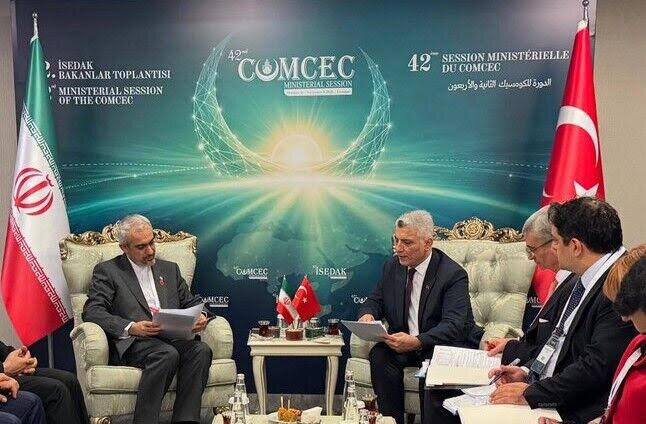
Seyyed Ali Madanizadeh, Minister of Economic Affairs and Finance of the Islamic Republic of Iran, in a meeting with Omer Bolat, Minister of Trade of the Republic of Turkey, emphasized strengthening customs and border cooperation between the two countries.
At the meeting, the two sides agreed to establish a joint working group and hold continuous meetings among directors of border customs offices with the aim of reviewing, following up, and resolving executive and operational problems.
Facilitating truck traffic and drafting a timetable for the transit of goods and services between the two countries were among the other important axes of the meeting. The parties also emphasized the need for round-the-clock, 24-hour operation of border customs offices with the aim of increasing exchange capacity, reducing truck stoppage time, and accelerating trade processes.
At the meeting, the situation of the Bazargan border and the existing issues and problems at this important trade crossing received special attention. The Turkish side’s ongoing plan to renovate and modernize customs offices and its impact on traffic and goods transit processes were also discussed and exchanged.
In this regard, the two sides emphasized the need for coordination to facilitate passage and prevent disruption in the flow of trade.
Activating and effectively using the capacity of other shared borders for the movement of trucks and passengers, as well as managing and facilitating the passage of sensitive consignments, were among the other topics raised at the meeting. The parties emphasized maximum use of the capacity of border crossings and the creation of necessary coordination to smooth traffic at these borders.
The formation of a joint working group for the two countries’ free trade and industrial zones was also raised in the negotiations. In this area, the parties emphasized accelerating the review of documents and proposals related to this working group and preparing the ground for the start of its activities.
In another part of the negotiations, the problems and obstacles facing the activities of Turkish companies in Iran were reviewed, and emphasis was placed on the need to follow up and resolve the issues of these companies and provide suitable conditions for the continuation and development of their economic and investment activities.
At the end, Iran’s Minister of Economic Affairs and Finance and Turkey’s Minister of Trade, emphasizing the importance of economic and trade relations between the two countries, stressed the continuation of dialogue, strengthening coordination among executive and customs bodies, and following up on agreements through joint mechanisms with the aim of facilitating trade, developing transit, and expanding economic cooperation.
Turkey became Iran’s first export destination; positive trade balance of $654 million
Iran-Turkey trade in the first half of the current Iranian calendar year (March 21-September 21), reached $7.914 billion with 10.3% growth; Iran’s exports increased by 56.1%, and Turkey became the country’s first export destination; imports declined.
According to a report by the Mehr News Agency, review of Iran’s foreign trade statistics in the first six months of 1405 shows that the value of trade exchanges with Turkey rose from $7.173 billion in the same period last year to $7.914 billion. Accordingly, trade between the two countries increased by about $741 million.
This growth occurred while Iran’s total foreign trade value decreased from about $54.666 billion in the first half of 1404 to $41.798 billion in the same period this year. On this basis, Turkey’s share of Iran’s total foreign trade increased from 13.1% to 18.9%.
Of course, the increase in Turkey’s share is not solely due to growth in bilateral exchanges; the decline in the value of Iran’s trade with other trading partners also contributed to raising this share.
One of the most important developments in Iran-Turkey trade in the first half of this year was the change in the composition of the two countries’ exchanges in favor of Iran’s exports.
In the first six months of 1404, Iran’s imports from Turkey accounted for 61.7% and exports to Turkey for 38.3% of the value of bilateral trade. But in the same period of 1405, the share of Iran’s exports increased to 54.1%, and the share of imports decreased to 45.9%.
A review of export details shows that the value of goods exported from Iran to Turkey rose from $2.744 billion in the first half of last year to $4.284 billion in the first six months of this year. Accordingly, Iran’s exports increased by about $1.54 billion and registered 56.1% growth.
This performance occurred while the total value of Iran’s exports in the same period decreased by about 25%, and exports to Turkey, contrary to the general trend of the country’s exports, increased significantly.
On the other hand, the weight of exported goods to Turkey also rose from about 5.057 million tons to 7.172 million tons, indicating 41.8% growth. Also, the average customs value per ton of exported goods increased from about $543 in the same period last year to $597.
A comparison of these indicators shows that the main part of the growth in export value to Turkey was due to an increase in the volume of exported goods; estimates indicate that about three-quarters of the increase in export value is related to the growth in the weight of goods, and the remaining part is related to the increase in average unit export value.
On the other side, Iran’s imports from Turkey in the first half of 1405 declined in value. The value of imports fell from $4.429 billion in the first six months of last year to $3.63 billion in the same period this year, equivalent to about $799 million and an 18% decrease.
However, a review of the weight of imported goods presents a different picture of the import trend. The weight of imports from Turkey not only did not decrease but increased from about 3.626 million tons to 3.81 million tons; thus, the weight of imported goods grew by 5.1%.
Along with the increase in weight and decrease in import value, the average customs value per ton of imported goods also fell from about $1,222 to $953.
This difference shows that a decline in import value does not necessarily mean a decrease in the volume of imported goods or a uniform drop in product prices, and a change in the composition of imported goods, including an increased share of heavier goods with lower unit value, can be effective in reducing the average value per ton.
Iran’s trade balance with Turkey became positive
The combined increase in exports and decrease in imports caused Iran’s trade balance with Turkey to become positive in the first six months of this year, after registering a significant deficit in the first half of last year.
Based on published statistics, Iran had a trade deficit of $1.685 billion with Turkey in the first half of 1404; but in the same period of 1405, this situation changed, and the two countries’ trade balance reached a surplus of $654 million.
Accordingly, Iran’s trade balance with Turkey improved by about $2.339 billion. Of this improvement, about $1.54 billion resulted from increased exports, and about $799 million resulted from decreased imports.
On this basis, about 66% of the improvement in the trade balance came from increased exports, and 34% came from decreased imports. Therefore, the growth of Iran’s exports is considered the most important factor in turning the trade deficit into a surplus in exchanges with Turkey.
Turkey became Iran’s first export destination
Changes in bilateral Iran-Turkey trade also changed Turkey’s position among Iran’s export destinations.
In the first half of 1404, Turkey was Iran’s fourth export destination after China, Iraq, and the United Arab Emirates; but in the first six months of this year, with increased exports to Turkey and decreased exports to the other three major destinations, Turkey rose to first place among Iran’s export destinations.
According to customs statistics, the value of Iran’s exports to China in this period decreased by 52.5%, to the UAE by 49.4%, and to Iraq by 30%. In contrast, Iran’s exports to Turkey increased by 56.1% and reached $4 billion and 284 million.
As a result, Turkey’s share of the total value of Iran’s exports increased from 10.6% in the first half of last year to 22% in the first six months of this year.
Of course, Turkey’s rise in rank is not limited solely to export growth to this country; the decline in exports to other major destinations also played a role in this ranking change—a matter that further highlights the importance of diversifying export markets and maintaining access to the Turkish market.
In total foreign trade as well, Turkey obtained the position of Iran’s second trading partner. In the first six months of 1405, the UAE ranked first with $8.982 billion, and Turkey with $7.914 billion, and China with $7.808 billion took second and third places, respectively.
The gap between the value of Iran’s trade with Turkey and China was only about $106 million; therefore, relatively limited changes in exchanges in later periods could swap the positions of these two countries.
In the import sector, Turkey also remains Iran’s third import origin after the UAE and China.
Bazargan tops customs for exports to and imports from Turkey
A review of customs details of Iran-Turkey trade shows that Bazargan Customs was the most important point of registration for exports to Turkey. In the first six months of 1405, out of a total of $4,284,020,000 in Iran’s exports to Turkey, $1,643,630,000 was registered at Bazargan Customs. Accordingly, Bazargan ranks first among export customs with a 38.3% share.
After Bazargan, Tabriz Customs with $293,880,000, Lamerd Special Economic Zone with $285,470,000, Rafsanjan Special Economic Zone with $266,860,000, and West Tehran Customs with $180,520,000 ranked next.
These five customs offices accounted for a total of 58.1% of the value of Iran’s exports to Turkey, and the share of other customs offices was $1,795,660,000, equivalent to 41.9%.
In the import sector, Imam Khomeini Port Special Economic Zone, with $724,800,000, was the largest origin for registering imports from Turkey. After that were Bazargan Customs with $433,720,000, Tehran Customs with $348,380,000, Imam Khomeini Airport City Free Zone with $329,850,000, and Mazandaran-Amir Abad Free Zone with $228,650,000.
The total value of imports registered at these five customs offices reaches about $2,065,400,000, equivalent to 56.9% of Iran’s total imports from Turkey. Other customs offices also registered $1,566,570,000, equivalent to 43.1% of imports.
The difference in weight and value of imports registered at different customs offices also shows that the composition of imported goods is not the same at customs origins; for example, the value of imports registered at Imam Khomeini Airport City is high compared with its weight, while at Imam Khomeini Port the weight of imported consignments is higher.
Sustainability of trade growth with Turkey depends on export diversification and infrastructure strengthening
The overall changes in Iran-Turkey trade in the first half of 1405 indicate the strengthening of Turkey’s position in Iran’s foreign trade; however, a review of the statistical details shows that to assess the sustainability of this trend, in addition to the value of exchanges, attention must also be paid to the composition of exported and imported goods, continuity of demand, and transportation capacities.
Therefore, although Iran-Turkey trade grew in the first half of this year contrary to the declining trend of the country’s foreign trade, and the trade balance also changed in Iran’s favor, maintaining these achievements will depend on removing trade barriers, diversifying exports, identifying goods effective in trade growth, and strengthening border infrastructure, especially at the Bazargan crossing.
source: tehrantimes.com