Iranian House of Cinema French Embassy willing to implement cultural cinematic programs
Iranian House of Cinema, French Embassy willing to implement cultural, cinematic programs
TEHRAN – Homayoun Asadian, CEO of the Iranian House of Cinema, met with Pierre Cochard, the French Ambassador to Tehran, on the sidelines of the “Nouvelle Vague” (New Wave) session in Tehran and discussed expanding cultural cooperation and organizing joint cinematic programs.
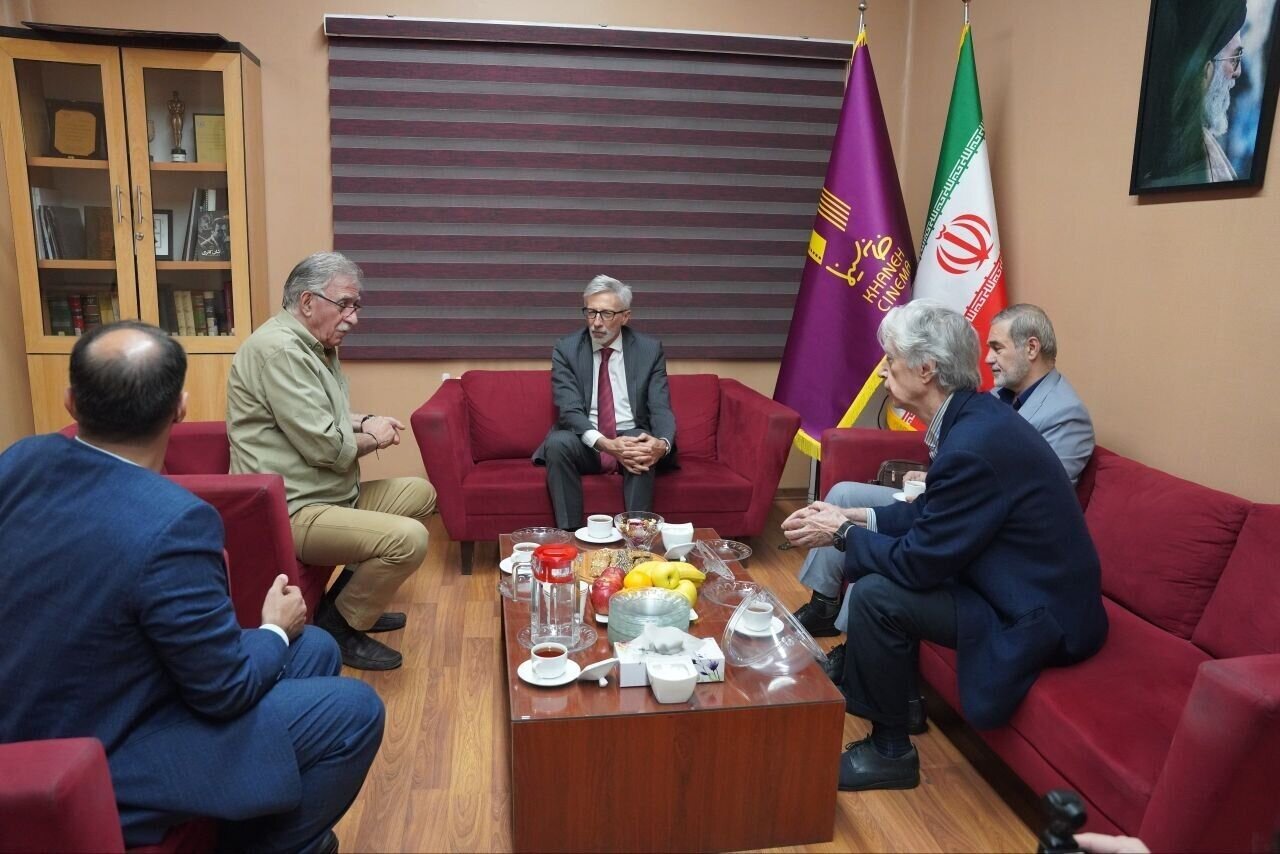
During the meeting on Wednesday, Asadian said: “I am pleased that you visited the headquarters of this professional institution, a place that hosts various cultural programs. We are all familiar with the French New Wave, filmmakers such as Godard and Truffaut, and works like ‘Breathless’,” IRNA reported.
Referring to the historical significance of the French New Wave, Asadian remarked: “The New Wave is one of the pinnacles of cinematic history and an influential movement in world cinema. Organizing programs such as ‘Dialogism’ and readings regarding the French New Wave helps enhance cinematic knowledge and fosters cultural connections between nations.”
He provided an overview of the institution’s organizational structure and duties, explaining: “The Iranian House of Cinema oversees 33 professional guilds; it manages guild-related affairs as well as issues such as insurance for its members. Alongside professional activities, it holds a diverse range of cultural programs. We host documentary screenings every week, and the Screenwriters’ Guild also organizes programs for screenplay analysis. Furthermore, as part of our social responsibility, we have various programs on our agenda; for instance, a performance regarding the Minab school tragedy was held earlier this year.”
Commenting on the differences between American and European cinema in terms of narrative and character development, Asadian added: “American cinema typically depicts the world in a binary of good versus evil and rarely delves into the gray areas of character and situation. In contrast, in European cinema, the boundaries between good and evil are not clearly defined.”
He also noted the history of French filmmakers in Iran, stating: “Albert Lamorisse produced the documentary ‘The Lovers’ Wind’ in Iran and, tragically, passed away during an incident in this country.”
Referring to the state of Iranian cinema, the Asadian noted: “In the past year, the outbreak of war caused Iranian cinema to experience a certain level of decline. In the current situation—which is neither war nor peace—investing in any activity, including cinema, faces difficulties. However, in terms of screenings, conditions have improved, and some films have achieved good box office results. In such times, gathering and engaging in dialogue is essential and must be prioritized.”
Asadian concluded by referencing his training at the Institute for the Intellectual Development of Children and Young Adults (Kanoon), noting: “I was trained at Kanoon, where studying and screening the works of filmmakers like Jacques Tati and Robert Bresson was always a focus.”
Following this, Pierre Cochard said: “We, at the French Embassy, are ready to cooperate with the Iranian House of Cinema in implementing cultural programs. If the opportunity arises, we could organize programs virtually through collaboration with French experts. We hope a structure is established that allows civil society organizations to expand their cultural ties.”
Reflecting on his history in Iran, the ambassador added: “About thirty years ago, during President Hashemi Rafsanjani’s administration, I was working at the French Embassy in Iran and have very fond memories of that era. I have now been back in Iran for one and a half years.”
Regarding the status of Iranian cinema, Cochard remarked: “Iranian cinema is very well-known in France. Iran and France share similarities in their support for independent cinema, as both countries follow somewhat similar systems.”
Referring to France’s support for independent films, the Ambassador noted: “Fortunately, the French film industry resists ‘Americanization.’ There is also a union across Europe tasked with supporting independent European cinema. Independent cinema holds a special place in Europe, and individuals like Woody Allen have also found success there.”
Finally, mentioning the prominence of performing arts in Iran, Cochard said: “Theater also has a significant presence in Iran, and people show a great interest in this art form.”
In the concluding part of the meeting, Bahman Namvar Motlagh, a scholar and professor, commented on the stature of French cinema, stating: “French cinema possesses an exceptional character. The central theme of the programs we are organizing is ‘Dialogism,’ and we intend to expand this approach within Iranian cinema.”
The third session of the “Dialogism in World Cinema” series, focusing on the French New Wave, was held at the Iranian House of Cinema in Tehran with the presence of Rouhollah Hosseini, Deputy of Technology Development and Cinematic Studies at the Cinema Organization, and Farzad Motamen, a film director.
At the beginning of the session, Meysam Yazdi, the scientific secretary of the program, stated: “The third program in the ‘Dialogism in World Cinema’ series—organized in collaboration with the Art and Literature Comparative Studies Association of Iran—is dedicated to the French New Wave.”
Referring to the film “New Wave” directed by Richard Linklater, he added: “This film by an American filmmaker was one of the notable works at the 2025 Cannes Film Festival. This work provides an opportunity for a dialogue between American and French cinema.”
During the session, excerpts from Richard Linklater’s “New Wave” were screened for the attendees.
Meysam Yazdi, highlighting the educational aspects of Linklater’s “New Wave,” remarked: “This film is an educational work with many nuances and details that can be instructive for film students. Jean-Luc Godard passed away in September 2022, and Linklater’s film is a frame-by-frame reconstruction of segments from Godard’s ‘Breathless’.”
Farzad Motamen, discussing the production costs and conditions of “Breathless,” said: “This film was made with a budget of 400,000 francs, which was equivalent to $80,000. Considering current exchange rates, this amount would be roughly $876,000 today—which is not a very large sum for producing a film. The film was shot in just 22 days. As François Truffaut once said, ‘Breathless’ divided cinema into ‘before’ and ‘after’ it.”
Later in the session, Rouhollah Hosseini discussed the stylistic features of the French New Wave, stating: “The New Wave is typically recognized by stylistic traits such as handheld camerawork in the streets, low production costs, improvised or semi-improvised dialogue, jump cuts, and similar elements. However, the New Wave absorbed these stylistic features through a series of dialogues with various other fields. In essence, these stylistic characteristics are the result of a form of ‘dialogism’.”
SS/SAB
source: tehrantimes.com