First national Irandokht festival highlights women in Zaribafi weaving in Isfahan
First national Irandokht festival highlights women in Zaribafi weaving in Isfahan
TEHRAN – The first national Irandokht festival, focusing on the role of women practicing the traditional weaving art of Zaribafi, was held on Feb. 21 in the ancient city of Isfahan.

The event took place at the University of Isfahan with the participation of women artisans, cultural officials and handicrafts activists, according to organizers.
Officials described the festival as a platform to highlight women’s identity and promote traditional arts in Isfahan province.
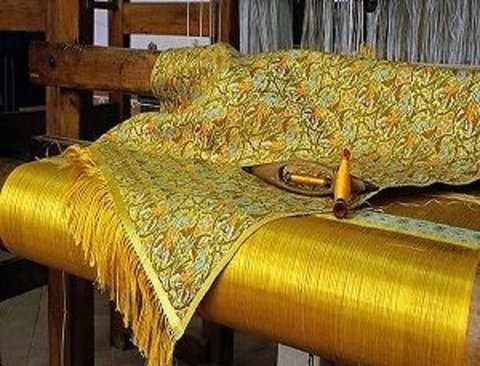
Zaribafi, also known as gold lace work, is a traditional weaving technique associated with Isfahan. The craft involves the use of gold, silver and silk threads and requires specialized skills.
Nourollah Abdollahi, deputy for handicrafts and traditional arts at the Isfahan province’s Cultural Heritage, Tourism and Handicrafts Department, said on the sidelines of the festival that the event was organized in cooperation with the Isfahan Governorate, the provincial Cultural Heritage Department, the national Deputy for Handicrafts and Traditional Arts, Isfahan Municipality, the provincial Technical and Vocational Organization, and several other organizations.
He said works by artists were presented in three competitive sections: design, research and women’s social dress.
Abdollahi described the Zardokht festival as an opportunity to introduce the artistic capacities of women artists in Isfahan.
“Zaribafi, as one of the traditional handicrafts of Isfahan, is a symbol of the cultural identity of this land, and supporting such arts means safeguarding part of Iran’s history and civilization,” he said.
He added that holding such festivals could contribute to empowering women artists, creating sustainable employment and expanding handicrafts markets.
Abdollahi also stressed the need to link traditional arts with innovation.
“The combination of traditional art with the contemporary outlook of the younger generation can help maintain the dynamism and continuity of Iranian handicrafts at the global level,” he said.
According to scholars and historians, Zaribafi dates back to the Sassanid period, a historical era noted for developments in weaving in Iran.
The craft involves fine weaving techniques and the use of gold, silver and silk threads. Artisans say the materials and skills required make the products valuable and costly.
AM
source: tehrantimes.com