DOE aims to bolster environmental ties with Indonesia
DOE aims to bolster environmental ties with Indonesia
TEHRAN – The head of the Department of Environment (DOE), Shina Ansari, and his Indonesian counterpart, Mohammad Jumhur Hidayat, have discussed ways to promote environmental cooperation.
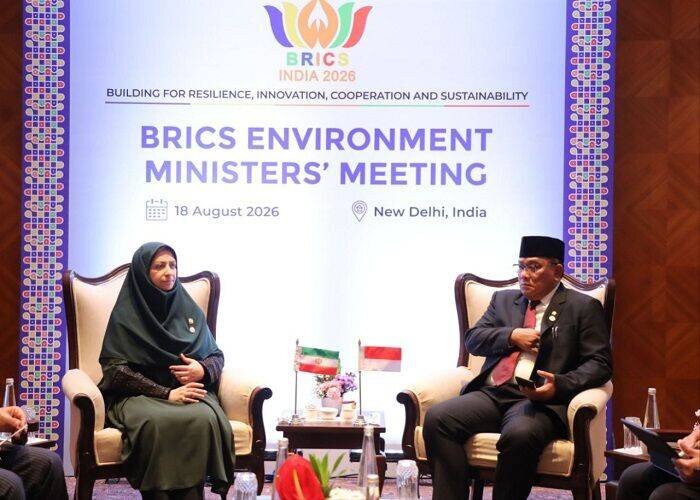
The officials met on the sidelines of the 12th BRICS Environment Ministers’ Meeting held on August 18 in New Delhi, India, IRNA reported.
During the meeting, the two sides underscored developing collaborative efforts. Hidayat stressed the need for the expansion of specialized and technical environmental interactions between the two countries. Expounding on Indonesia’s measures to combat plastic pollution, the official highlighted the importance of cooperation and consensus among nations regarding operational waste management mechanisms, particularly in coastal areas.
For her part, Ansari emphasized shared environmental potential of Iran and Indonesia, stressed the necessity for reinforcingcollaborative efforts, exchanging expertise and technical knowledge, and expanding the scope of expert interactions.
Underscoring the importance of preserving biodiversity, she proposed to collaborate on protecting natural habitats, forests, water resources, and marine ecosystems, as well as addressing climate change and managing waste.
Ansari also held a meeting with Russian officials; the meeting focused on potentials to deepen cooperation in environment sector.
The discussions at 12th BRICS Environment Ministers’ Meeting were held under the theme ‘Building for Resilience, Innovation, Cooperation and Sustainability’. The meeting provided a great platform for BRICS member countries to exchange views, build consensus and strengthen practical cooperation on pressing environmental challenges.
Speaking at the 12th BRICS Environment Ministers’ Meeting in New Delhi on Tuesday, Ansari called for closer environmental cooperation among BRICS member states, describing their combined capacities in natural resources, biodiversity, coastal and marine ecosystems, and other environmentally valuable areas as a “historic opportunity” to address the growing global environmental crisis.
She proposed placing environmental security alongside energy and food security, establishing a BRICS network to monitor and assess environmental damage resulting from armed conflicts and climate change, creating a rapid-response mechanism for marine pollution and hazardous-material spills, and expanding the exchange of technologies and expertise for restoring damaged ecosystems.
She also called for stronger cooperation between BRICS countries and specialized international organizations to address the environmental consequences of crises and to pursue accountability for those responsible for environmental destruction, based on the principle that “the polluter must pay.”
Ansari further proposed launching discussions on a common BRICS framework for environmental protection during armed conflicts.
Emphasizing the direct link between peace, security and environmental protection, she called for a joint mechanism among BRICS members to monitor and respond to environmental damage caused by armed conflicts and climate-related crises.
“Environmental protection is not merely a theoretical issue; it is directly linked to the peace and security of countries and peoples,” Ansari said.
MT/MG
source: tehrantimes.com