The weapon shifting Yemens frontlines
The weapon shifting Yemen’s frontlines
TEHRAN – While Yemeni missile attacks on Riyadh airport capture global headlines, another tactical weapon has shifted the frontlines near Bab al-Mandab.
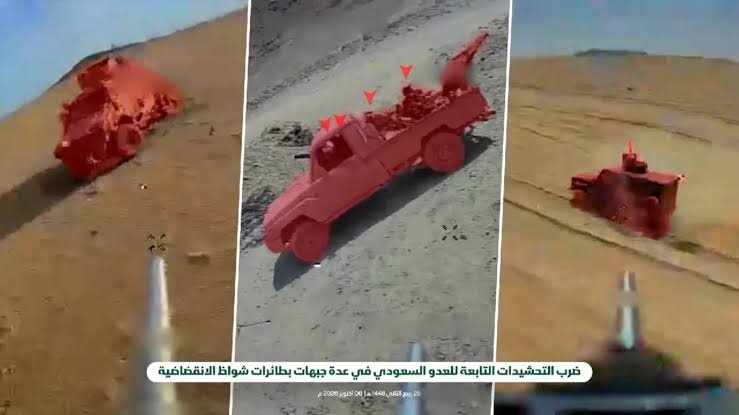
Recent military developments on Yemen’s southwestern fronts have introduced a new and significant tactical shift in the course of the confrontation between Sanaa and Riyadh. This came after the Yemeni Armed Forces (YAF) announced that the Shawaz drone had entered operational service for the first time.
The drone was used to target Saudi-backed forces advancing from the direction of Lahij governorate toward the areas of Al-Wazi’iyah district (Taiz governorate) and Kahbub (strategic high ground), both adjacent to the international shipping lane at Bab al-Mandab.
Over the past week, the YAF’s War Media division has released footage documenting operations to repel and pursue Saudi-backed forces and their vehicles using this type of drone. The footage shows substantial losses among those fighters at their field positions, creating an obstacle to attempts to break through in this strategically vital sector.
The YAF has succeeded tactically in turning attempted breakthroughs into mobile killing zones that consume Saudi manpower and equipment. This type of weapon, the Shawaz drone, along with preemptive operations, may have played a decisive role in that success. As a tactical weapon, the Shawaz drone has transformed both the battlefield equation and the battle of competing narratives.
Characteristics and capabilities
Shawaz drones represent a model of low-cost, highly maneuverable tactical weaponry. They are remotely operated and provide live video feeds of the battlefield. Their significance extends beyond carrying out offensive strikes; they also provide real-time reconnaissance and intelligence on enemy deployments and the scale of their movements. This gives field commanders the ability to manage engagements according to the principle of proportionality while minimizing human losses along the front lines.
The footage released by the War Media division shows that Shawaz operations should not be dismissed as another set of battlefield images. By analyzing the footage, several functions of this tactical weapon can be identified.
Direct pursuit and attack
The Shawaz drone’s role is not limited to pursuing and targeting military vehicles, armored vehicles, fortified positions, and barricades. The footage has also demonstrated its ability to pursue individual personnel on the battlefield, as seen in the recent operations in Kahbub and Al-Wazi’iyah.
Dual offensive and intelligence-gathering
The Shawaz performs two military functions: offensive operations and intelligence-oriented reconnaissance. It enables the YAF to monitor enemy mobilizations, deployments, numbers, weapons, and other relevant details. This allows the Sanaa government to apply the principle of proportionality in accordance with the demands of the battlefield.
Remote observation and engagement
The drone provides the ability to observe and engage targets remotely, thereby reducing the potential human losses among YAF personnel in direct confrontations.
Psychological impact and the changing battlefield equation
Psychologically and perceptually, the documented footage has created an atmosphere of fear and deterrence among the YAF’s foes on the ground. Its effects have extended beyond the immediate battlefield, influencing the wider environment surrounding Saudi-backed forces.
These drones have established a new battlefield reality, forcing Riyadh’s forces to abandon their customary displays of strength through large military convoys and adopt dispersed positions and defensive concealment out of fear of this weapon.
Yet these measures have neither protected them nor prevented them from being targeted. This is evident in the footage of the Kahbub and Al-Wazi’iyah operations, in which Shawaz drones pursued individual personnel and military vehicles in multiple directions, while those targeted were gripped by fear and panic.
The recent footage of Shawaz drones and their operations also brings to mind the attack drones used by Hezbollah against the Israeli Occupation Forces (IOF) in southern Lebanon. Those drones became a source of terror and an enduring nightmare for the regime’s occupying troops. Their impact was not confined to those on the battlefield; their psychological effects extended to political and military decision-making circles, as well as field commanders.
There is little doubt that Yemeni drones exert a similar psychological impact on Saudi-backed forces operating on the Yemeni battlefield.
Battlefield implications and the battle of competing narratives
An examination of recent developments suggests that the latest offensive operations have inflicted substantial attrition on Saudi-backed forces between Lahij governorate and Bab al-Mandab. These operations have come alongside earlier missile and aerial strikes that inflicted extensive losses on Saudi forces, their vehicles, and their modern armored equipment, whether American-made or Saudi-made.
The footage recorded by Shawaz drones, together with material documented by Yemen’s War Media division, has made a significant difference in the media battle over competing narratives. The visual evidence, captured by both the Shawaz drones and War Media cameras, has refuted claims promoted by Saudi news outlets and some Arab television channels that Saudi-backed forces had “established full control over Bab al-Mandab” or were “advancing toward Al-Mokha.”
The Shawaz footage, by contrast, showed that these forces are suffering military attrition, including casualties and equipment losses, while operating under severe psychological pressure. It also showed these forces retreating rather than occupying positions from which they could launch an offensive and establish control.
In the battle of narratives and competing accounts, the YAF’s documented operations, filmed both from the air and on the ground, have demonstrated a consistency between the battlefield situation and the account presented to the public. When the YAF or military sources announce an operation or achievement and substantiate their claims with footage, their account becomes more convincing.
This visual documentation has played a central role in dismantling opposing media narratives and has reinforced the YAF’s claimed operational and psychological advantage in managing the battlefield.
The opposing side, by contrast, has gone beyond propaganda. It now lies more often on the falsification of facts and the construction of reality through crude, repetitive, and theatrical claims unsupported by any visual evidence.
This was evident last week when Saudi outlets claimed to have “secured control over Bab al-Mandab and advanced toward Al-Mokha.” Within hours, however, those claims, and those promoting them, had been discredited because they lacked elements of credibility, as well as tangible evidence from the battlefield.
source: tehrantimes.com