TMoCA cinematheque to show French documentary about Iran
TMoCA cinematheque to show French documentary about Iran
TEHRAN – Concurrent with the exhibition “In Search of Iran: In the Collection of the Tehran Museum of Contemporary Art,” a program titled “In Search of Iran in Cinema” will be held at the museum’s cinematheque.
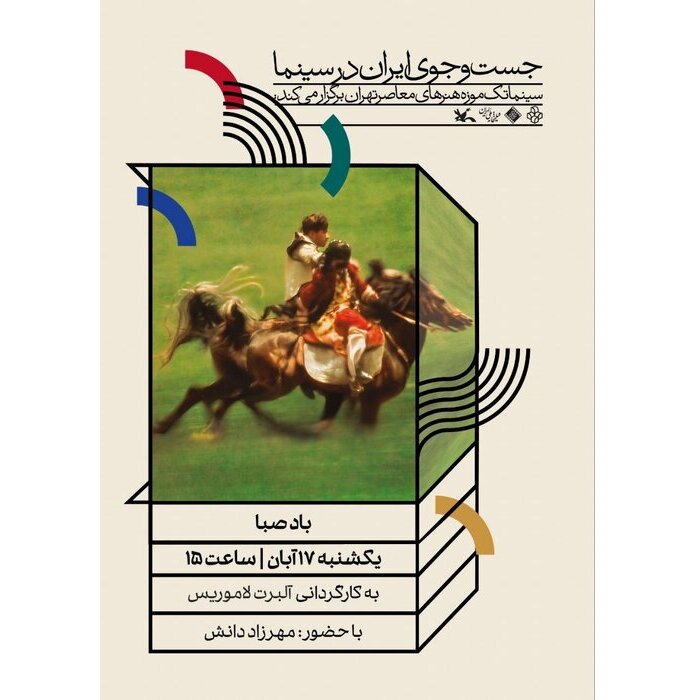
Films in which Iran plays a prominent role will be screened at the event, which will run for five weeks at the Tehran Museum of Contemporary Art (TMoCA) in Tehran, IRNA reported.
Under this approach, the documentary “The Lover’s Wind,” directed by Albert Lamorisse, will be screened on Sunday, November 8. After the screening of the 1978 movie, Mehrzad Danesh, a film critic, will speak about it.
“The Lovers’ Wind” is a dreamlike documentary film that scans Iran’s stunningly variegated landscape of both natural and manmade wonders.
The documentary beautifully depicts landscapes of Iran from an aerial view, showing waters of the Caspian Sea in the north and the Persian Gulf in the south, palm trees in the west, central deserts and eastern meadows, ruins of ancient historical sites like the city of Susa and Persepolis, as well as people in different locations.
About 85 percent of the film was shot from a helicopter. Although it shows real images of the country, there is a fictional (and funny at times) narration by the acclaimed Iranian veteran filmmaker, writer, editor, translator, and voice artist Manouchehr Anvar.
Iranian traditional and ethnic music also accompanies the picture and narration. The composition by Master Hossein Dehlavi includes several pieces with Persian instruments tar, tonbak, santur, ney, and violin, greatly contributing to each scene.
In Persian, the title of the movie is translated as “Saba Wind,” coming from the northwest, symbolizing the message of love. The film is lyrically narrated by the voice of the wind.
Born in Tehran, Anvar, 98, graduated from the Royal Academy of Dramatic Art in London and started his artistic career in 1958 after returning to Iran.
Lamorisse (1922-1970) was a French filmmaker, film producer, and writer of short films, which he began making in the late 1940s. He also invented the strategic board game Risk in 1957.
In the filmmaking sphere, he invented a steady-camera mounting system for helicopters, called “helivison,” which helped support his lifelong fascination for filming aerial subjects, as well as for filming ground-level subjects from the air.
Thanks to his unique aerial documentary capabilities, Lamorisse was commissioned in 1968 by the Iranian Ministry of Art and Culture to make a film celebrating Iran’s magnificent culture, from ancient times up to the present, that would feature his patented aerial photography.
Lamorisse completed much of the shooting for the film in 1969, most of which (about 85 percent) featured aerial cinematography, in accordance with his own poetic view of what the film should be about. He came back in 1970 to shoot more material featuring modern industrial developments, but was killed in a helicopter crash while filming the Karaj (Amir Kabir) Dam 63 km northwest of Tehran.
His widow and son, both of whom had been working as assistants on this film’s production, completed the film, based on his production notes, and released it eight years later in 1978. It was nominated for a posthumous Academy Award for Best Documentary Feature in 1979.
There is also a postscript to the story, in the form of a six-minute film. After the accident at Karaj, Lamorisse’s camera was retrieved from the wreckage, and its film was developed in the lab of the Ministry of Art and Culture. The footage was then edited together by Iranian members of his original crew to create a tribute to the director and a memorial of his death.
The “In Search of Iran in Cinema” program will continue, in the coming weeks, with films including “O Iran” by Nasser Taqvai, “Ferdowsi” by Abdolhossein Sepanta, “Iran Is My Land” by Parviz Kimiavi, and “Bashu, the Little Stranger” by Bahram Beyzai.
The program is organized in collaboration with the National Film Archive of Iran and the Institute for the Intellectual Development of Children and Young Adults (Kanoon). Admission is free and open to the public.
SS/SAB
source: tehrantimes.com