Iran Azerbaijan sign economic coop document covering 10 sectors
Iran, Azerbaijan sign economic co-op document covering 10 sectors
TEHRAN – Iran and Azerbaijan signed a cooperation document outlining joint economic initiatives across 10 sectors, including transport, energy, electricity and water, the Ministry of Transport and Urban Development said.
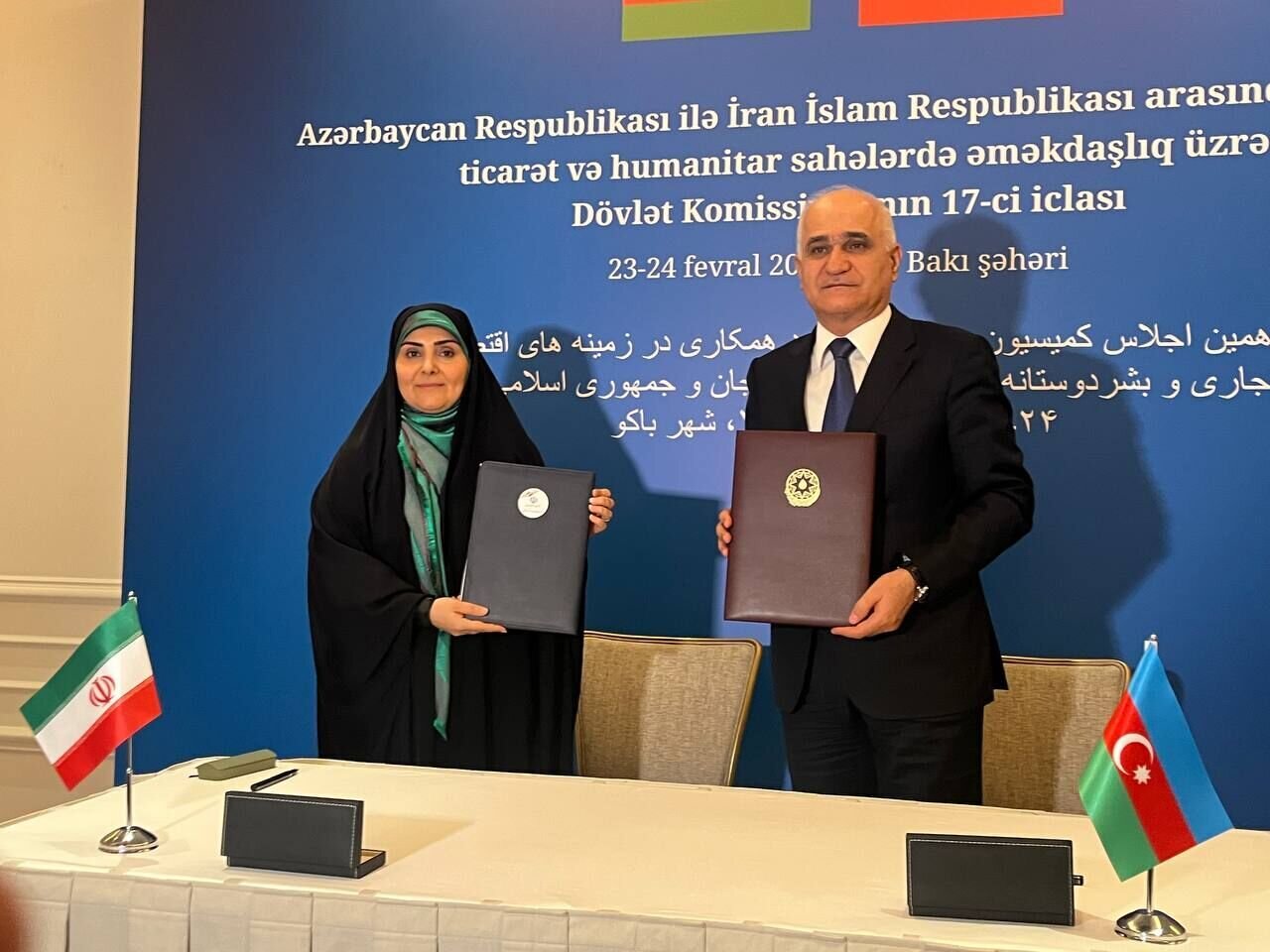
The memorandum was signed at the 17th session of the Iran–Azerbaijan Joint Economic Committee by Iran’s Minister of Transport and Urban Development Farzaneh Sadegh and Azerbaijan’s Deputy Prime Minister Shahin Mustafayev.
The document sets out a framework for bilateral cooperation in infrastructure, energy and water projects, as well as broader economic, social and cultural fields.
In transport, the two sides agreed to expand cooperation in road transport, border management and railway development.
Key infrastructure projects include the Kalaleh–Aghband bridge, the Astara bridge, the widening of the Kalaleh–Jolfa road, the Kalaleh–Siahroud rail link and the launch of the Astara rail terminal at the shared border, with both parties emphasizing the need to accelerate implementation.
In the energy sector, the sides approved cooperation in oil blocks one and two and agreed to establish a joint working group to follow up on related memoranda of understanding.
In electricity, agreements covered plans to connect the power grids of Iran, Azerbaijan and Russia, as well as electricity exports from Azerbaijan to Iran.
Water cooperation focused on joint projects related to the Khoda Afarin and Qiz Qalesi dams and power plants, along with the Marazad–Orduabad hydropower project.
The agreement also includes understandings in areas such as tourism, agriculture, customs, industry, investment, sports and youth affairs, paving the way for deeper economic ties and expanded strategic cooperation between Tehran and Baku.
Iran targets 15m tons of transit on western INSTC corridor by 2030
Speaking at the committee meeting, Sadegh said Iran aims to increase transit volumes on the western branch of the International North–South Transit Corridor (INSTC) to 15 million tons by 2030.
She said trade between the two countries has reached around $650 million over the past two years, with exchanges following an upward trend. Drafting a trade cooperation roadmap could provide clearer prospects for expanding economic relations, she added.
Transport and transit were identified as key pillars of cooperation. Over the past year, about 120,000 Iranian trucks transited through Azerbaijani territory, while more than 50,000 Azerbaijani trucks entered Iran, reflecting substantial cross-border freight activity.
Sadegh said achieving the 15-million-ton transit target by 2030 would require more than tripling current fleet movements, underscoring the need to upgrade border infrastructure and streamline procedures.
She noted that construction of the Kalaleh–Aghband bridge is in its final stages and is expected to play a significant role in facilitating transit flows and trade once completed.
Energy cooperation and joint projects on the Aras River were also cited as strategic areas of collaboration, alongside agriculture, tourism — particularly health tourism — and broader cooperation in industry, investment and infrastructure.
The minister said expanding cooperation across transport, energy and trade could strengthen economic integration and support regional connectivity goals under the INSTC framework.
The seventeenth meeting of the Iran–Azerbaijan Joint Economic Committee opened in Baku on Monday, focusing on transport links, border infrastructure and broader economic and cultural ties.
Farzaneh Sadegh, Iran’s minister of transport and urban development, and Shahin Mustafayev, Azerbaijan’s deputy prime minister, are co-chairing the two-day meeting in the Azerbaijani capital.
Amin Taraffo’, director general for international affairs at Iran’s Ministry of Transport and Urban Development, said discussions would cover all areas of bilateral cooperation, with a focus on programs to be implemented by next year. The final agreements are to be signed in the form of a memorandum of understanding by the heads of the two delegations.
Iranian minister of transport and urban development met with the president of the Republic of Azerbaijan to discuss the review of new railway infrastructures and joint oil fields, the development of transportation cooperation, the utilization of new border infrastructures, and cooperation in the energy sector.
Farzaneh Sadegh, on Monday morning (February 23) before the start of the 17th meeting of the Iran-Azerbaijan Joint Economic Committee, met with Ilham Aliyev, the president of Azerbaijan. During this meeting, she conveyed the greetings of Masoud Pezeshkian and stated that the president of Iran places special importance on relations with the Republic of Azerbaijan.
Emphasizing the historical, religious, and cultural ties between the two countries and the importance of bilateral relations, the minister discussed the most important priorities for bilateral cooperation in the economic fields, which were also emphasized by the president of Azerbaijan.
The development of cooperation in the transportation sector, particularly strengthening regional connections and transit corridors, was one of the most important topics of the discussion. Furthermore, expanding energy cooperation, utilizing new border infrastructures, and constructing new railway infrastructures between the two countries were other subjects raised during this meeting.
The two sides also exchanged views on the joint oil fields in the Caspian Sea and the method of extracting resources from these fields, as well as the development of bilateral and multilateral regional cooperation with neighboring countries in the fields of transportation and energy.
In this meeting, it was emphasized that the results of the discussions held within the framework of the 17th Joint Economic Committee meeting should be finalized and new agreements between the two countries should be drafted and signed.
It is noteworthy that in this meeting, Ilham Aliyev, the president of the Republic of Azerbaijan, while thanking for the message from Masoud Pezeshkian, the president of Iran, expressed his satisfaction with the expansion of bilateral relations and emphasized: "The projects implemented jointly by Iran and the Republic of Azerbaijan will provide extensive opportunities for both countries as well as the region."
Officials described transport and the development of shared border infrastructure as central pillars of Tehran–Baku relations, citing progress over the past 18 months in both rail and road connectivity.
Talks are expected to address joint projects including the completion and inauguration of the Kalaleh–Aghband bridge, development of the Aras corridor, widening of the 107-kilometer Kalaleh–Jolfa road, construction of the Kalaleh–Siyahroud railway, and cooperation on the Khoda Afarin and Giz Galesi dam and power plant projects.
The sides will also assess implementation of commitments made at the previous commission meeting in Tehran and review customs and land transport procedures with a view to removing bottlenecks and accelerating trade flows.
Transit cooperation under the International North–South Transport Corridor (INSTC) will be another key topic, including a target of reaching 15 million tons of transit cargo by 2030 along the corridor’s western branch linking Iran, Azerbaijan and Russia.
Trade expansion, efforts to finalize a preferential trade agreement, energy cooperation in gas, electricity and oil, and collaboration in tourism — particularly health tourism — are also on the agenda.
On the sidelines of the meeting, Sadegh is scheduled to hold separate talks with Azerbaijani ministers to discuss ways to deepen bilateral economic and infrastructure ties.
Officials from both countries expressed hope that the commission’s decisions would translate into tangible benefits for businesses and citizens, strengthening economic, transit and cultural exchanges between Tehran and Baku.
Back in October 2025, Farzaneh Sadegh announced that Iran, Russia, and Azerbaijan had finalized a comprehensive roadmap to increase the volume of goods transiting among the three nations to 15 million tons annually. The plan, she said, marks a major milestone in efforts to strengthen regional connectivity through the International North–South Transit Corridor (INSTC).
Speaking to reporters after attending trilateral and bilateral meetings in Baku on October 12, 2025, Sadegh described the gathering as “highly effective and long-awaited,” emphasizing that the new roadmap would help resolve logistical bottlenecks and enhance coordination across multiple transport sectors.
She underlined that the Rasht–Astara railway project remains the “missing link” in the corridor, and completing it is key to unlocking the full potential of the INSTC. “Land acquisition for the remaining sections will be completed by the end of this year, and we expect significant physical progress within the next three years,” she said.
Sadegh added that the meetings also focused on streamlining customs procedures, improving border infrastructure, and enhancing truck and rail traffic between the three nations. Customs representatives discussed plans to establish a shared digital platform to simplify clearance processes and improve coordination among border authorities.
The minister proposed that Iran, Russia, and Azerbaijan jointly develop an action plan within three months to achieve the 15-million-ton target by 2030. “The document will be signed at the next summit of the three countries’ leaders,” she noted, describing it as a blueprint for transforming regional trade routes into a reliable and efficient logistics network.
Sadegh also revealed ongoing efforts to launch scheduled freight trains along the western branch of the corridor and offer preferential tariffs to attract more cargo. “Consistency and predictability in logistics services are essential to achieving our targets,” she said.
In her bilateral meeting with Azerbaijan’s Minister of Transport and Digital Development Rashad Nabiyev, Sadegh highlighted the growing momentum of cooperation between Tehran and Baku, noting that transport issues have become a core focus of the Joint Economic Commission. “We have had the most frequent exchanges with Azerbaijan in the past year, which shows the strategic importance of these ties,” she said.
She emphasized the need to form joint technical committees to address problems faced by Iranian carriers at Azerbaijani border crossings and to work toward practical solutions in upcoming meetings.
The discussions also covered major projects such as the Kalaleh–Aghband border bridge and the Iran–Azerbaijan–Georgia corridor, which are expected to significantly expand trade and transit opportunities once completed.
Sadegh invited Nabiyev to visit Iran for continued discussions, while the Azerbaijani minister welcomed Iran’s proposals and reaffirmed Baku’s readiness to cooperate in resolving obstacles to transportation and trade.
Sadegh concluded that the agreements reached in Baku will accelerate progress toward the shared goal of achieving 15 million tons of transit by 2030, strengthen Iran’s position as a regional transport hub, and deepen the partnership among the three neighboring countries.
EF/MA
Photo: Iran’s Transport Minister Farzaneh Sadegh (L) and Azerbaijan’s Deputy Prime Minister Shahin Mustafayev pose with signed MOU documents in Baku on Monday.
source: tehrantimes.com