International competition launched to design Minab school martyrs memorial
International competition launched to design Minab school martyrs’ memorial
TEHRAN – The International Landscape and Memorial Space Design Competition for the Minab School Martyrs’ Cemetery has been officially launched, seeking to create a lasting memorial space that honors the victims, preserves their stories and conveys a message of peace and resistance.
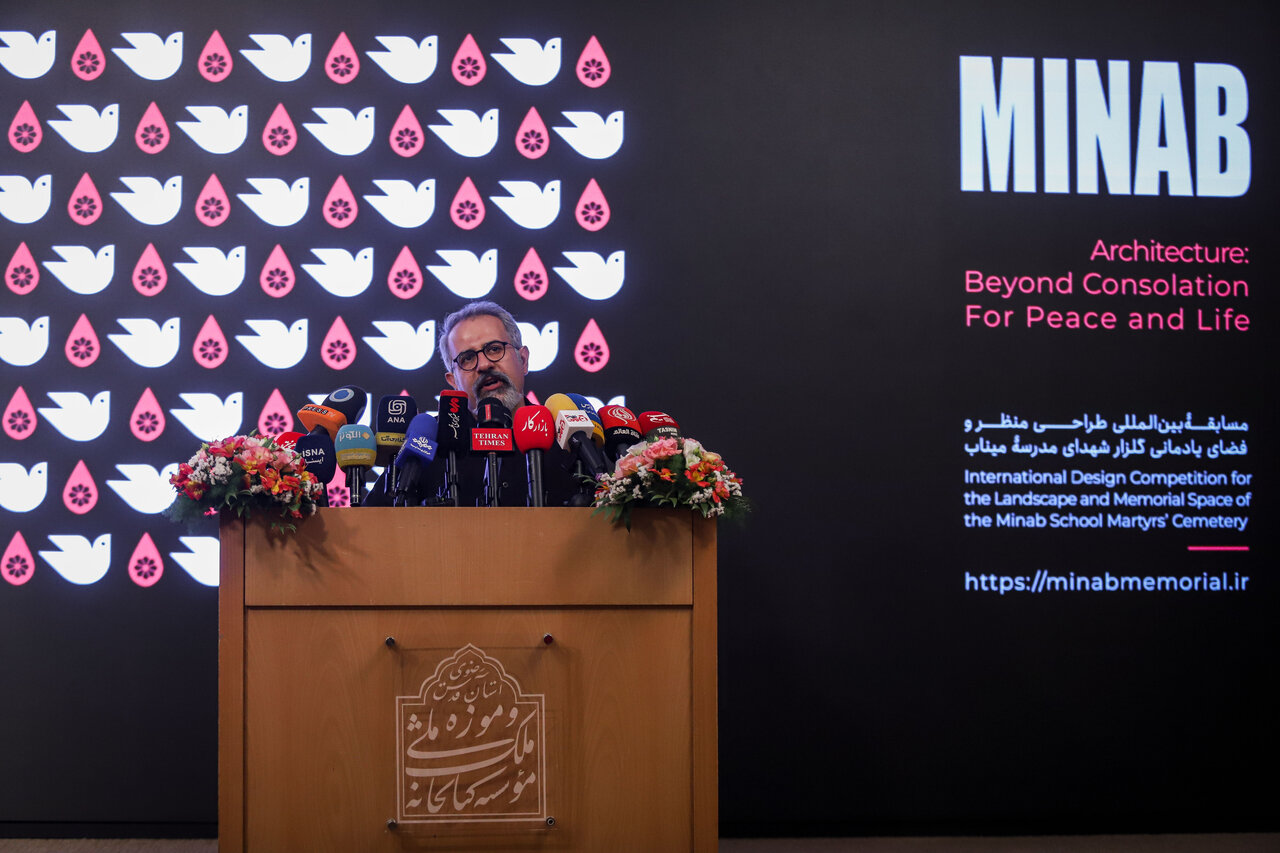
The competition, titled “Architecture; Beyond Consolation — for Peace and Life,” was introduced during a press conference held at the Malek National Library and Museum on Monday, where organizers outlined the objectives, design approach and procedures of the international call.
According to Saeid Mehrpouya, director of the competition, the project follows a decision by the custodian of Astan Quds Razavi to address the site and ultimately construct the memorial. The initiative was also proposed within the legal and planning framework of Iran’s Supreme Council of Urbanism and Architecture.
Mehrpouya said the organizers deliberately chose an open competition format to allow architects and consultants from different backgrounds to participate and to ensure that the project would not be confined to a predetermined design.
“The subject is not limited to designing a particular structure. We want architects and designers to engage with the social and human dimensions of the event and develop a space that can convey its deeper meaning,” he explained.
The competition focuses on a memorial site of about 8,000 square meters in Minab, where the tragic event left a profound impact on families and the wider community.
Mehrpouya said that during visits to Minab, the organizers encountered a site whose physical appearance itself had become part of the collective memory of the tragedy. The school where the incident occurred is planned to be transformed into a museum, while the burial site constitutes another important part of what the organizers describe as a wider memorial chain.
The overall concept includes four interconnected elements: the school that witnessed the tragedy, the burial site, other memorial manifestations of the victims, and a plan to establish eight schools across the country bearing the names of the children.
The competition itself represents the second link in this chain.
According to Mehrpouya, research conducted during visits to the site and examination of accounts surrounding the incident revealed a broader story of innocence and victimhood. The organizers also collected stories about the children, their teachers, their parents, the school bus driver and other individuals connected with the school.
Mehrpouya emphasized that the burial ground cannot be understood simply as a cemetery. For many families, he said, the site has become an extension of their homes and a place where they come to feel close to their children, talk to them and share their grief.
“This is a different kind of space,” he said, adding that the responsibility of the participating architects is to discover the stories embedded in the site and transform them into a tangible and perceptible spatial experience.
The organizers have defined the design process around several stages, beginning with the tragedy itself. They argue that although the catastrophe occurred in a single moment, its consequences continue in the lives of survivors, families and the city.
The second stage concerns the victims themselves and the task of creating a physical space for something that did not previously exist. The architects are expected to address not only the memorialization of the victims but also the transformation of an ordinary piece of land into a place that narrates their deaths, the suffering of their families and the collective trauma of Minab and Iran.
The organizers have also given the competition an international dimension. Mehrpouya said that memorials for victims of major tragedies are not exclusively national phenomena and that the issue of responsibility surrounding such events has attracted international attention.
He stressed that the architectural response should go beyond consolation and address the future as well.
The concept of peace adopted by the competition, he explained, does not signify surrender. Rather, it represents resistance to humiliation and violence. “We did not start the war and we are deeply committed to peace, but we stand against tyranny and brutality,” he said, stressing that the memory of the victims should remain alive for future generations.
The competition's organizers believe the site also represents a form of trauma for survivors. Although the school has been destroyed, memories of the bombing continue to recur in the minds of those who witnessed or survived the event. The memorial, therefore, is expected to contribute to transforming the site into a place where memory can be preserved while creating a sense of calm and continuity.
A visual identity has also been developed for the competition. Its main elements include birds and a drop of blood, with an uncolored, hollow bird serving as the symbol of Makan Nasiri, a missing martyr.
The competition's official call will be published following the press conference on the dedicated website, Minabmemorial.ir, in Persian, English, Arabic, Russian, French, Spanish and Chinese. The website includes the names and ages of the victims, as well as accounts related to their lives, in an effort to provide participants with a deeper understanding of the subject.
The organizers said information about the competition has also been sent to Iran’s cultural and diplomatic representatives in several countries.
The competition offers a total of 24 billion rials in prizes. Five leading entries will receive awards, while eight additional projects will be recognized. In total, 13 selected designs will be honored.
An international jury is being formed, with organizers currently negotiating with several potential international jurors. The final composition of the jury is expected to be announced in the coming weeks. The panel will include three Iranian academic architects and two international architects, representing different generations of professionals.
After the jury selects the top 20 to 30 proposals, the organizers plan to submit them to specialists from other disciplines for multidisciplinary review and expert feedback.
Mehrpouya stressed that the competition will not end with the announcement of the winning design. Instead, the selected proposal will move into the contracting and construction stages, making the competition part of a larger process aimed at creating a physical memorial.
The winning and selected designs will also be compiled into a book and will go on display in different exhibtions, allowing the public to experience the different architectural interpretations of the tragedy and the message of the memorial.
Registration for the competition will begin next week through the official website and will be free of charge. Participants will have 10 weeks to prepare their proposals, followed by a 10-day evaluation period. The competition is expected to conclude in late November, with organizers hoping to complete part of the memorial project before the anniversary of the tragedy in February.
The competition's guidelines have been designed in two sections: the first presents the story and context of Minab, while the second sets out the competition's rules and requirements.
Organizers said they hope the project will ultimately create a memorial landscape unlike existing examples in Iran and elsewhere, transforming a site of profound loss into a place where memory, mourning, resistance, peace and hope for future generations can coexist.
The US-Israeli missile strike on Minab’s Shajareh Tayyebeh Girls’ School and Rahpouyan-e Khalij-e Fars Boys’ School on February 28 left a deep scar on the city. The attack struck shortly before 11 a.m., when students were attending classes. A second missile hit a prayer hall where students had gathered after the initial strike. Rescue and identification operations continued for days, followed by the burial of the victims.
SAB/
source: tehrantimes.com