The oil market now ignores Trumps messages
The oil market now ignores Trump’s messages
Kayhan, in an article, examined Trump’s desperation in the current situation. Trump’s frustration and anger come at a time when Axios acknowledged that changes in oil prices in response to Trump’s social‑media posts about the Iran war have steadily declined over time.
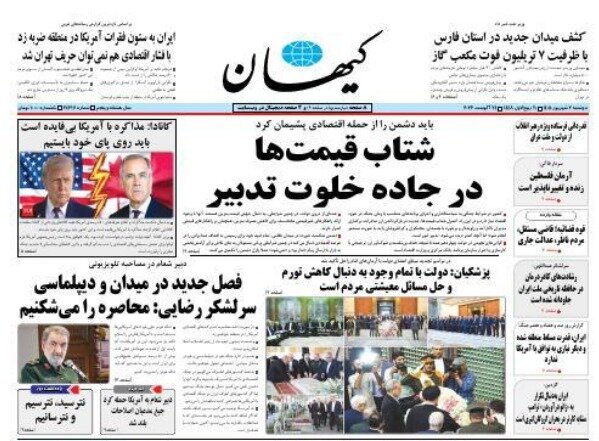
Fluctuations in oil prices ripple across the US and global economies, and the conflict has caused unprecedented disruption in supply. In the early weeks, markets overreacted to many of Trump’s posts. But for months now, the market has been ignoring them, because they do not reflect reality and have no connection to the number of barrels actually leaving the Strait of Hormuz. The erosion of Trump’s influence over oil markets carries political consequences, as Democrats use energy prices as a cudgel against Republicans in the midterm elections. In the first few months, the White House was highly successful in controlling the narrative and pushing prices down — but it has now lost that leverage.
Ettelaat: Maintaining good relations with neighbors is essential for Iran
Ettelaat evaluated the Mecca Pact. Although Iran currently has no tension with Turkey or Pakistan, it is possible that under certain circumstances — and with Saudi financial assistance to these two countries combined with US provocation — tensions could emerge. For this reason, Tehran need not be overly sensitive about the Mecca Pact. If the pact adopts a strongly oppositional stance toward Israel, it would be an opportunity for Tehran. If it remains indifferent toward Israel but shows sensitivity toward Iran, it becomes a threat. The Mecca Pact could, at a critical moment, be inflamed by Riyadh and Washington, clouding Iran’s relations with Ankara and Islamabad. In any case, it is better for Iran to keep its good relations with its neighbors strong and to further reinforce them, while remaining highly alert and prepared for all possible scenarios, risks, and breaches of commitment, even in the worst case.
Arman-e-Emrooz: A challenging situation
Arman-e-Emrooz assessed the intensification of US sanctions and the naval blockade of Iran through three possible scenarios. Amid these developments, it appears that one of the three scenarios will soon unfold. One possibility is that the Trump administration steps back and announces progress in negotiations, meaning the harsh sanctions will not be implemented. The second scenario is that the plan is announced and executed, but after a short period it is quietly set aside as both sides show flexibility and a negotiation process begins. The third possibility is that the severe economic sanctions continue until the US midterm elections and are then accompanied by military strikes to reshape the situation on the ground. Each of these three scenarios has its supporters, but two factors strongly influence them: first, the degree of firmness on current positions; and second, the election results soon to be held in the US and Israel.
Shargh: A crisis in the global economy
Shargh, in an analysis, examined the global economic crisis triggered by the closure of the Strait of Hormuz. The flight of oil tankers from the strait amid escalating military tensions has pushed shipping rates to more than four times their pre‑war levels. The closure of the Strait of Hormuz has now become a crisis for the global economy. This unprecedented surge in transport costs brings a chain of negative consequences. First, the final cost of oil for consumer countries has risen sharply, meaning greater pressure on household budgets and intensified inflation worldwide. Second, countries lacking sufficient strategic reserves face serious challenges in securing their required oil and may encounter fuel shortages. Third, higher transport costs raise the final price of essential goods and industrial raw materials, since oil plays a key role in the production and transport of many products. The closure of the Strait of Hormuz has imposed a full‑scale economic crisis on the world — one that affects all countries, from major importers to ordinary consumers.
Resalat: Disrupting the Arab–American coalition‑building game
American strategists openly speak of efforts to unite the Persian Gulf Arab states against Iran. Our diplomacy must anticipate the adversary’s moves and deprive them of the pretexts for coalition‑building. The agreement to restore relations with Saudi Arabia, along with expanding ties with the UAE and Qatar, must be upgraded from a mere political truce to deep economic and security linkages. If the Persian Gulf states develop tightly interwoven commercial and economic interests with Iran, they will not easily play Washington’s anti‑Iran puzzle. We must show our neighbors that regional security is unified and indivisible. Any provision of bases to the United States or the Israeli regime for actions against Iran’s interests endangers the security and investment climate of the entire region.
At the same time, proposing non‑aggression pacts and cooperation for securing maritime navigation neutralizes the pretext for foreign fleets to remain present.
source: tehrantimes.com