Ensuring national cohesion boosts the countrys bargaining power globally
Ensuring national cohesion boosts the country’s bargaining power globally
Javad Emam, spokesperson for the Reform Front, told Etemad newspaper—while discussing the country’s current circumstances and the need to strengthen national unity and social cohesion in confronting the United States— that recent days have once again placed the region and the world amid rapid and complex developments.
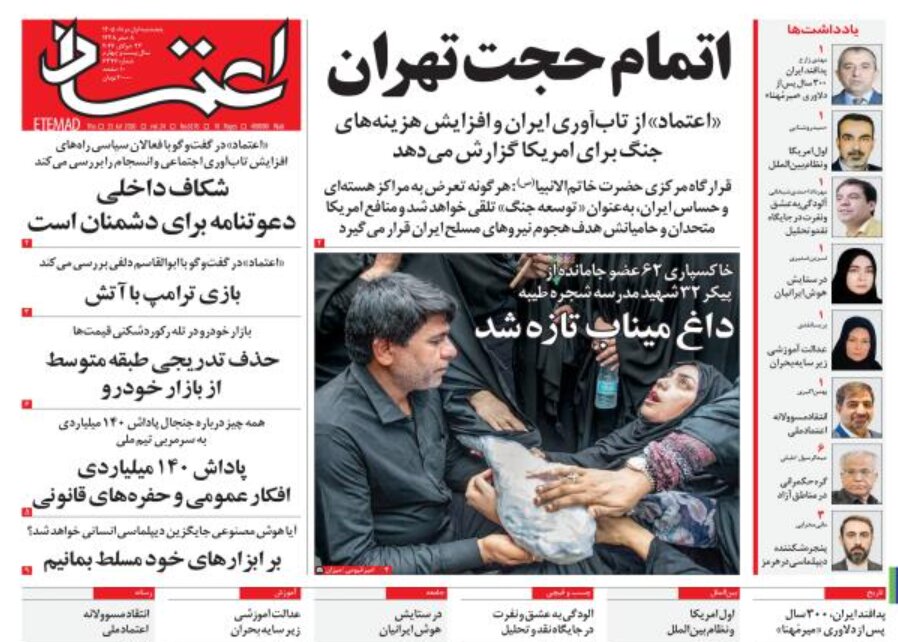
In such conditions, what can guarantee the country’s security, stability, and authority more than anything else is not political or media commotion, but rather the preservation of national unity and the reinforcement of social cohesion. He added that in the face of external pressures and threats, including the hostile policies of the United States and “bloodthirsty Israel,” the country’s foremost need is maintaining internal solidarity. Undoubtedly, national power is not formed solely on the foreign‑policy stage; it originates from within society. The stronger this internal capital becomes, the greater the country’s bargaining power in the international arena, enabling it to navigate political, economic, and security challenges at lower cost.
Shargh: A green light for enrichment in Riyadh
Shargh analyzed the imminent comprehensive US–Saudi civilian nuclear agreement. According to Shargh, this civilian nuclear pact helps place Washington–Riyadh relations back on a more stable trajectory. The agreement is designed to deepen the strategic bond between the two capitals, especially as the ongoing war with Iran has imposed additional strain on bilateral ties. Saudi officials have sought such an agreement partly as a deterrent against Iran. During the current year’s war with Iran, Riyadh relied on the United States to supply interceptor missiles for air defense against Iranian projectiles. Nevertheless, Saudi officials remain concerned that US policies in the Middle East—including its partnership with Israel—may increase risks for Saudi Arabia and other Persian Gulf Arab states. For this reason, Saudi diplomats have pursued talks with Iran—two countries that restored diplomatic relations in 2023 through Chinese mediation.
Farhikhtegan: Surprises from two weeks of clashes
Farhikhtegan highlighted the strengthening of Iran’s attacks over the past two weeks. According to the paper, several upgrades in Iran’s operations have emerged—constituting a major and disappointing setback for the enemy. These attacks showed increased accuracy due to the use of new missiles or upgraded systems. The rate of penetration through enemy air defenses rose. Real‑time intelligence was visible in strikes on missile launchers in Kuwait. Most importantly, supply routes were blocked. The closure of the Strait of Hormuz prevented the transfer of large volumes of equipment by sea to the Persian Gulf. After the war, the Fujairah route in the UAE—used to bypass Hormuz and supply Persian Gulf bases—was shut down. Then Oman’s Duqm port was targeted. Now, with Iran striking Aqaba port in western Jordan—linked to the Red Sea—another major supply route has been hit. In parallel, Yemen is preparing to increase insecurity along Red Sea maritime routes.
Javan: Iraqi Kurdistan—long‑standing base of the Zionist regime and a regional threat
Javan, discussing the IRGC’s attack on Iraqi Kurdistan, wrote that after the start of the second phase of the war, the IRGC—while fighting on the American‑Israeli front—launched a new wave of strikes on Iraqi Kurdistan, the base of separatist armed groups and a hub of Israeli activity. These operations are not limited to securing Iran’s internal borders; they constitute a broader effort to counter Israeli presence and activity along Iran’s western frontier. The proximity of separatist Kurdish groups and Israeli operatives has turned the region into a center of instability. Any negligence, the paper argues, would impose high costs on national and regional security. Iran’s actions send a clear message: Iran’s security is a red line, and no power can cross it.
Arman‑e-Melli: Iran’s step‑by‑step strategy
Arman‑e-Melli assessed Iran’s strategy against the American‑Israeli adversary, writing that based on published information, the United States has suffered heavy blows at its regional bases—especially in Jordan and Kuwait—reflecting Iran’s defined strategy. Tehran has emphasized this “step‑by‑step” model not only in the current round of tensions but also during the Ramadan war and even earlier, in the 12‑day conflict. This means Iran has tried to respond to damage and attacks in a way that allows it to steer the confrontation according to its own design, while ensuring that its counter‑response—whether against the US or Israel—is calibrated so the adversary cannot excessively amplify the impact of its own actions.
This is precisely the logic of the escalation‑ladder model.
source: tehrantimes.com