Why Aramco Stands Alone
Why Aramco Stands Alone
Introduction: Redefining the Geopolitics of Capital In traditional international political economy literature, the strategic posture of Middle Eastern energy titans is typically evaluated through the lens of supply security and price stabilization. Recent structural shifts in global financial markets, however, reveal a fundamental evolution in their core function: these mega corporations have transitioned from mere commodity suppliers into primary liquidity pumpers across Western financial arteries.

At the apex of this paradigm sits Saudi Aramco. The free cash flow generated by this state energy giant directly conditions asset pricing on Wall Street and underwrites innovation financing across Silicon Valley. A granular analysis of Aramco’s financial statements and capital circulation channels demonstrates how the balance sheets of regional hydrocarbon majors serve as an implicit—yet indispensable—liquidity backstop for U.S. financial benchmarks.
1. Aramco as a Discrete Asset Class
Grasping Aramco’s structural footprint requires applying the core quantitative frameworks of corporate finance. In modern valuation methodology, true wealth creation hinges on sustained net income generation and free cash flow yield. Financial market data underscores an enduring structural constant within the Middle Eastern political economy:

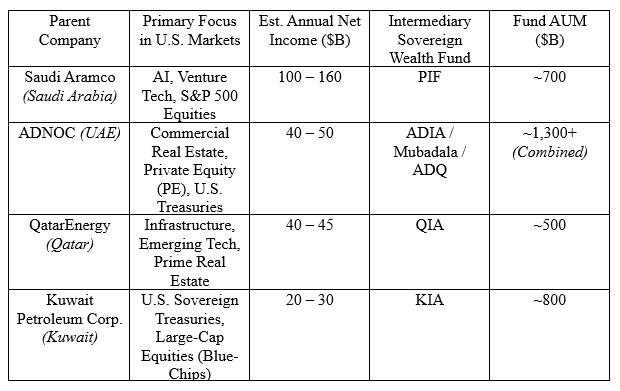
with annual net income ranging between $100 billion and over $160 billion—contingent on Brent crude cycles—Aramco not only surpasses the aggregate profitability of the region's top 50 listed entities (including major banking institutions, petrochemical conglomerates, and telecom operators), but also competes head-to-head with U.S. Mega-Cap Tech titans like Apple and Microsoft.
This sheer scale of capital accumulation elevates Aramco beyond the conventional taxonomy of an energy firm, establishing it as a unique asset class in its own right. Bolstered by exceptionally high operating margins and unparalleled extraction cost efficiencies across Saudi reserves, the company possesses a structural buffer that renders its cash generation remarkably resilient against broader macroeconomic contractions.
2. The Spillover Mechanism: Petrodollar Recycling on Wall Street
The central question is how this massive accumulation of liquidity feeds into the U.S. financial system. The answer lies in Aramco’s dividend distribution mechanics.
Aramco distributes tens of billions of dollars in dividends annually. The lion’s share flows into the Saudi state treasury and, most notably, directly onto the balance sheet of the Public Investment Fund (PIF). This marks the origin of the liquidity spillover process. Because domestic markets lack the absorption capacity to digest capital at this scale, monetary theory dictates that these funds must be recycled into deep, highly liquid international capital markets to prevent domestic inflationary pressures1.
With a minimal time lag, this cash flow funnels into three primary vectors within U.S. capital markets:
* U.S. Treasuries: Anchoring interest rate dynamics while absorbing U.S. sovereign debt issuances.
* Real Estate Investment Trusts (REITs): Providing valuation stability across institutional real estate assets in major metropolitan areas.
* Block Equity Purchases in the S&P 500: Delivering direct structural support to the market capitalization of U.S. blue-chip equities.
Consequently, Aramco’s free cash flow functions as a systematic liquidity buffer for Wall Street, forging a deep structural transmission mechanism between crude oil prices and U.S. equity valuations.
3. The PIF Engine and Co-Investment Alpha in Emerging Tech
For U.S. private equity and venture capital firms, the most compelling dynamic in this capital cycle is the catalytic role played by the Saudi Public Investment Fund (PIF).
Dividend streams generated by Aramco have propelled the fund’s assets under management (AUM) well past the $700 billion threshold. PIF has evolved beyond a passive institutional LP, transforming into one of the anchor limited partners in top-tier, multi-billion-dollar Silicon Valley funds. For U.S. asset managers, accessing this capital pool unlocks distinct "co-investment alpha"—providing the scale required to underwrite high-conviction tech plays without overconcentrating single-fund capital.
Saudi Arabia’s broader strategic mandate to diversify away from a single-commodity economy toward frontier technologies directly channels petrodollars into U.S. innovation hubs. Aramco-derived capital is increasingly funding artificial intelligence architectures, hyperscale data infrastructure, autonomous computing systems, and clean-tech ventures. Beyond derisking early-stage positioning for American venture partners, this co-investment flywheel exponentially accelerates deployment scale and commercialization timelines across emerging tech ecosystems.
4. The Broader Capital Chain: Regional Hydrocarbon Giants
While Aramco commands the apex due to its sheer scale, any regional analysis remains incomplete without evaluating the financial behavior of the Gulf Cooperation Council’s (GCC) other three major energy anchors. Operating with tailored institutional structures, these state enterprises execute similar petrodollar recycling strategies, reinforcing the liquidity pipeline into Western markets.
A. Abu Dhabi National Oil Company (ADNOC)
ADNOC serves as the economic engine of the United Arab Emirates, deploying an advanced framework for petrodollar deployment. Generating an estimated annual net operating income between $40 billion and $50 billion, ADNOC has pioneered a structural capital-recycling model via strategic initial public offerings (IPOs) of its specialized subsidiaries (e.g., ADNOC Distribution, ADNOC Gas, and ADNOC Drilling).
The resulting cash flows capitalize Abu Dhabi’s sovereign triad: the Abu Dhabi Investment Authority (ADIA), holding roughly $990 billion in AUM; Mubadala Investment Company, managing over $300 billion; and ADQ. These institutional vehicles act as highly aggressive allocators across U.S. tech equities, private equity buyout funds, and prime commercial real estate in major financial centers like New York, London, and San Francisco.
B. QatarEnergy
In contrast to the crude-centric models of Aramco and ADNOC, QatarEnergy’s balance sheet is built on LNG market hegemony. Bolstered by recent geopolitical realignments in global energy trade and secured via multi-decade off-take agreements, QatarEnergy maintains a stable annual net income trajectory between $40 billion and $45 billion.
This steady free cash flow directly funds the Qatar Investment Authority (QIA), which manages over $500 billion in assets. QIA’s deployment strategy prioritizes strategic equity stakes in Tier-1 Western financial institutions, core infrastructure assets, and anchor commitments in U.S. venture capital vehicles.
C. Kuwait Petroleum Corporation (KPC)
Kuwait operates one of the oldest, most institutionalized petrodollar allocation frameworks globally. KPC generates an estimated net annual revenue ranging from $20 billion to $30 billion, subject to crude price volatility. Statutory mandates dictate that a fixed percentage of these hydrocarbon revenues automatically flow into the Future Generations Fund, overseen by the Kuwait Investment Authority (KIA).
Managing nearly $800 billion in assets, KIA represents one of the largest and most persistent institutional holders of U.S. sovereign debt, alongside core allocations in Wall Street’s blue-chip pharmaceutical and industrial sectors.
Summary Matrix: Capital Flows and Assets Under Management (AUM)
In conclusion, should military hostilities reignite, strategic logic suggests that Iranian targeting imperatives would focus on delivering attritional strikes against Saudi Aramco—the quintessential anchor underwriting U.S. financial and economic liquidity. By disabling a fraction of the firm's operational production capacity, Iran could inflict far more severe structural shocks on the U.S. economy than through any alternative strategic targets.
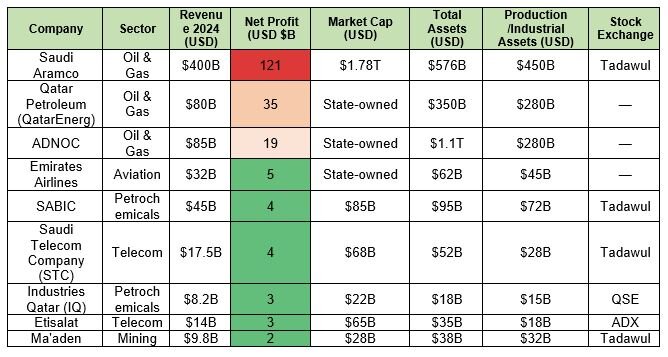
Appendix: Cash Flow Profile of the Region's Largest Entities with Financial Ties to the U.S.
Abbas Yazdani is a researcher specializing in finance and state-owned enterprises at the Growth Center of Imam Sadiq University.
source: tehrantimes.com