Memories of My Father offers intimate portrait of Martyr Sayyed Hassan Nasrallah
“Memories of My Father” offers intimate portrait of Martyr Sayyed Hassan Nasrallah
TEHRAN- “Memories of My Father,” written by Sayyed Mohammad Mahdi Nasrallah and translated into Persian by Bushra Sahebi, offers a firsthand account of the personal, family and ethical dimensions of Martyr Sayyed Hassan Nasrallah, the late secretary-general of Lebanon’s Hezbollah.
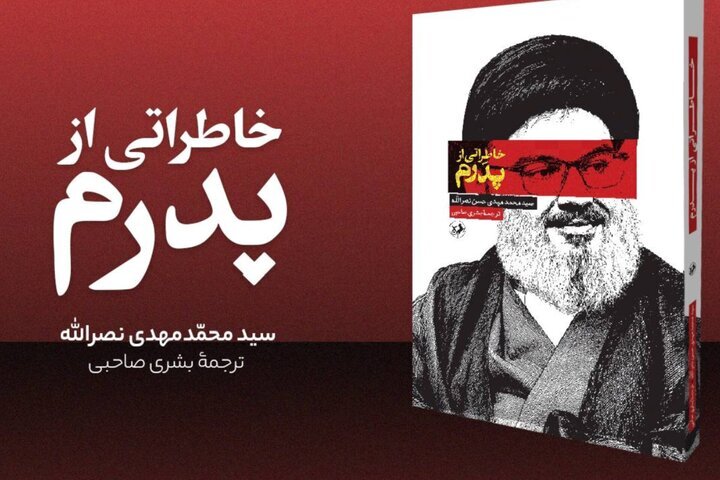
The Persian edition of the book has recently been published by Amirkabir Publications in Tehran, with the translation seeking to preserve the original tone and personal character of the author while presenting the work in accessible Persian.
Published on the occasion of the second anniversary of Nasrallah’s martyrdom, the book is described as the first official and intimate written work published by his family, providing an account of the resistance figure through the perspective of his son.
Originally written in Arabic under the title “Dhikrayati ma‘a Abi”, the book presents a personal portrait of Nasrallah’s life away from the public and political spotlight, focusing on his conduct and relationships within the family.
The work is divided into two main sections: “What I Heard from My Father,” based on accounts and recollections, and “What I Saw While Accompanying Him,” which draws on the author’s direct observations.
Across 82 narratives, the book recounts various aspects of Nasrallah’s life, including his affection toward family members, his attention to the upbringing of his children, and his role as a caring father and grandfather. It also touches on his simple lifestyle, his approach to reading and his close relationship with books.
A significant part of the memoir addresses how Nasrallah confronted hardship and lived under difficult security conditions, offering readers a perspective on his daily life that has received comparatively little attention.
“Memories of My Father” is aimed at readers interested in literature of resistance, the history of the region and contemporary history, providing a family-centered account of a prominent figure associated with Lebanon’s Hezbollah and the broader regional resistance movement.
Sayyed Hassan Nasrallah became secretary-general of Hezbollah in 1992, following the assassination of his predecessor, Sayyed Abbas al-Musawi. He led the movement for more than three decades, during a period that included the Israeli withdrawal from southern Lebanon in 2000 and the 2006 war between Hezbollah and Israel. Under his leadership, Hezbollah developed into a major political and military force in Lebanon and assumed a broader role in regional affairs.
Nasrallah was also widely known for his televised speeches, through which he addressed supporters and commented on major developments in Lebanon and the wider region. Born and raised in Beirut, he came from a family with roots in Bazouriyeh in southern Lebanon. While his public life was closely followed across the region, his personal and family life largely remained outside the spotlight.
He was tragically killed at the age of 64 during a series of intense Israeli airstrikes in southern Beirut on September 27, 2024.
The attack that claimed Nasrallah’s life was carried out by Israeli fighter jets targeting Hezbollah’s main headquarters, resulting in the martyrdom of several senior Hezbollah commanders and prominent Iranian Revolutionary Guards Lieutenant General Abbas Nilforoushan, who was present at the scene.
Under Nasrallah's leadership, whose name means "victory through God," Hezbollah evolved from a grassroots armed movement into the largest political party in Lebanon's recent history. Renowned for his captivating speeches, Nasrallah garnered attention throughout the West Asia and beyond, establishing himself as a significant figure within the Axis of Resistance, which includes Hezbollah, the Palestinian groups Hamas and Islamic Jihad, the Houthi movement in Yemen, and various Iraqi paramilitary factions.
SAB/
source: tehrantimes.com