Pezeshkian turned the United Nations into a court for American and Israeli crimes
Pezeshkian turned the United Nations into a court for American and Israeli crimes
In a note, Kayhan discussed President Pezeshkian’s forceful speech at the 81st session of the United Nations General Assembly in New York. The speech was a powerful response to the US president's absurd statements and shameless threats.
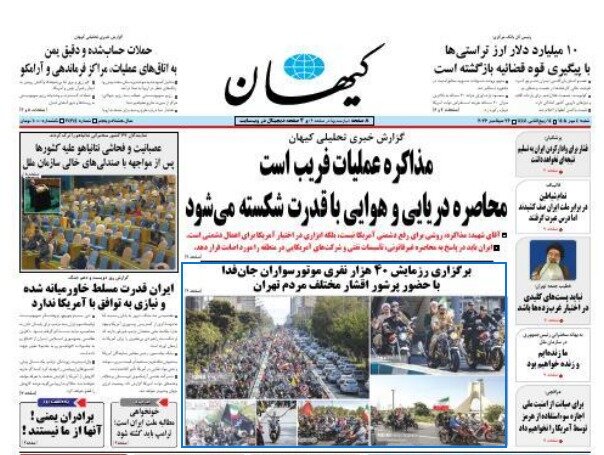
In those remarks, Trump openly displayed the logic of force and even threatened Iran with destruction. Iran's president transformed New York into a courtroom for judging the crimes of Washington and Tel Aviv. Pezeshkian challenged the West's double standards with firm reasoning. By emphasizing that the Iranian nation will never accept the language of bullying and needs no one's permission to defend its sovereignty, he demonstrated that American intimidation only strengthens Iranian unity and resistance. Thanks to the president for turning the UN podium into a stage for exposing global arrogance.
Siasat-e-Rooz: A project that failed
Siasat-e-Rooz devoted its editorial to the failure of the United States and Israel in their attempt to portray Iran as a weak and unsuccessful nation. This year's United Nations meeting was shaped by major developments in West Asia, ranging from American-Israeli terrorist crimes to the resilience and strength of the Iranian people, Iran's successful management of the Strait of Hormuz by its armed forces, and diplomatic efforts to pursue the country's legitimate rights. One of the key points is that despite US efforts to isolate Iran and present a negative image of the country, the authority displayed by President Pezeshkian and his decisive speech effectively undermined that scenario. Netanyahu, while boasting about attacks on Iran's nuclear facilities and claiming Iran could be destroyed, sought, much like Trump, to depict Iran as a defeated and collapsing state. However, Iran's initiatives effectively thwarted this plan. Likewise, Trump's speech and the media campaign conducted by Western outlets met a similar fate.
Iran: Strength for peace versus peace through strength
Pezeshkian's speech in New York should be regarded as Iran's first coherent strategic narrative following the war. The recurring theme of "strength for peace" throughout the President's remarks appears, first and foremost, to send a clear message to advocates of the doctrine of "peace through strength": that Iran has dedicated part of its peace-seeking strategy to comprehensive defense. At the same time, this message is unlikely to alarm international public opinion because Iran does not define national defense in opposition to negotiation and dialogue. On the contrary, its strategic narrative places military capability and diplomatic capability on equal footing. Perhaps more importantly, the logic of "strength for peace" is not limited to foreign policy. If power is used externally for defense and negotiation is employed externally to achieve peace, then the same principle can be applied to domestic politics. National unity and strength should not be used to eliminate opponents but rather to create the conditions necessary for dialogue and political coexistence.
Vatan-e-Emrooz: Iran has options beyond negotiation
Vatan-e-Emrooz analyzed the proper conditions for negotiations. The key lesson from negotiating with the United States is the need to distinguish negotiation from "dependence on negotiation." A country that engages in dialogue while simultaneously preserving its capacity for resistance, resilience, and choices is in a fundamentally different bargaining position from a country that ties all its hopes to reaching an agreement and continually highlights its vulnerabilities in pursuit of one. If some individuals in Iran favor negotiations, they should not naively try to convince the United States that Iran needs talks. Instead, they should focus on demonstrating that Iran possesses alternatives beyond negotiations. One must recognize a basic reality of diplomacy: in international politics, diplomatic respect and the possibility of agreement often arise not merely from expressing a willingness to talk, but from maintaining leverage, national resilience, and reduced vulnerability.
Shargh: The challenging path of diplomacy
In an article, Shargh examined recent developments in the dialogue process between Iran and the United States. These developments, including indirect talks in New York mediated by Qatar and several positive statements regarding the continuation of consultations, have created the impression that a new opportunity for reducing tensions may be emerging. The central issue, however, remains the significant gap between the positions and demands of the two sides. On the one hand, economic pressure, sanctions, and measures related to maritime restrictions continue from the American side. On the other hand, Tehran insists on a set of core demands, including an end to conflicts on all fronts, the lifting of sanctions, the release of frozen assets, and the removal of naval restrictions. Diplomacy can succeed only when it is accompanied by political will and reciprocal measures. Even if an opening exists for serious negotiations, internal disagreements and pressure from hardline factions and Tel Aviv could still obstruct progress toward mutual understanding.
source: tehrantimes.com