Explosion in oil prices Trumps nightmare
Explosion in oil prices: Trump’s nightmare
Kayhan wrote in an article about Iran’s optimal use of the current situation: The explosion in global oil prices is Trump’s nightmare. Iran is in a position where it can destroy the entire flow of Western energy. Targeting Iran’s infrastructure carries a cost that not only the United States, but the entire Western world cannot afford.
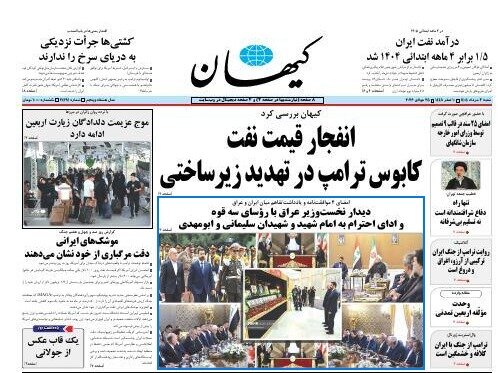
Trump speaks with force and threats, and the response to him must also be deterrent. When the US president threatens to strike Iran’s infrastructure, he must be confronted with the threat of destroying everything that shapes the Western world. We must impose an equation in our favor on the enemy at both diplomatic and military levels. If we want to increase security and deterrence, our response must be far more painful and far stronger. Weakness and passivity only give the enemy excuses. Any official active in the country must impose the equation of power on the enemy.
Siasat-e-Rooz: The United States is confused and angry
Siasat-e-Rooz analyzed Iran’s military response to US attacks. According to the paper, the missile and drone strikes by the Army and IRGC, carried out with complete precision and purpose, continue to destroy US bases in the region. The destructive drones and missiles of Iran’s armed forces strike US forces and bases in such a way that there is no ability to counter them. Rising casualties among the US terrorist military due to Iran’s attacks have left senior American officials—especially Trump—confused and angry. Heavy and widespread strikes by Iran’s Army and IRGC on US positions continue, even as the lying US president has so far said 106 times that we defeated Iran, and 95 times that we destroyed Iran. But the developments on the ground tell a different story, and punitive operations continue.
Hamshahri: This is how Iran fights
Hamshahri analyzed regional developments and Iran’s deterrent power. It wrote: The Persian Gulf region, in the past week, witnessed one of the most strategic military battles of recent decades—a battle that, although initiated by America’s aggressive attacks, ultimately saw Iran fundamentally reshape the military equations in West Asia, with consequences extending far beyond the battlefield. What was initially designed by the US as a “limited operation” against Iran became a stage for Iran’s deterrent power to emerge, marking strategic turning points—from control of the Strait of Hormuz and influence over the global energy market to precision missile and drone strikes—now recorded in the history of regional developments. Iran’s strategic blows, with significant losses and casualties for the US military, discredited Washington’s official narrative of the battlefield and confronted the Trump administration with serious domestic and international challenges. It is precisely due to such developments that regional observers emphasize a ‘reconfiguration of the balance of power in West Asia.’
Khorasan: Mossad’s footprint in US threats
Khorasan wrote about Trump’s recent threat: Trump once again openly threatened to bomb the Kolang mountain facility in Isfahan Province. Neither Trump nor the Americans have any reliable information about the activities of this site. The very important point, however, is the footprint of the Israelis in influencing the US president’s decision-making. Israel has reported that Iran has transferred centrifuges to the underground Kolang site—news that reflects the continued influence of Mossad on the decision-making system in the White House. As explained, the likelihood of success for such an operation is far lower than the likelihood of failure. Nevertheless, if the enemy once again miscalculates and attacks this facility, Iran’s response must not be limited to escalating the conflict or issuing symmetrical retaliations. Rather, the attack must be met with appropriate responses outside the current pattern of rising tensions—responses with new surprises that fundamentally alter the enemy’s calculations.
Ettelaat: We must break the defective cycle
Ettelaat analyzed Iran’s approach in the current situation, quoting military expert Hossein Kanani-Moghaddam: With rising tensions and speculation about military confrontation between Iran and the US or a return to diplomacy, analyzing the dimensions of ‘economic war’ and ‘war economy’ has become even more important. The cycle of war, negotiation, peace, and then ceasefire is defective, and we must break it. We must keep the Strait of Hormuz closed for at least three months so that America’s strategic oil reserves decrease. We are currently engaged in two wars: one is the economic war, and the other is the war economy. But in contrast, they are trapped in another issue: the war economy itself. America cannot endure a war economy, and right now it is taking the oil dollars of Arab countries. When Arab countries have no oil, they cannot pay America, and this will cause America to lose.
source: tehrantimes.com