Iran Iraq stress broader transport ties
Iran, Iraq stress broader transport ties
TEHRAN- Iran’s Minister of Transport and Urban Development, in a meeting with Iraq’s ambassador in Tehran, highlighted the deep historical, cultural, and religious ties between Iran and Iraq, emphasized developing bilateral transport links in the rail, road, air, and maritime sectors, and reported efforts to resolve flight problems between Tehran and Baghdad.
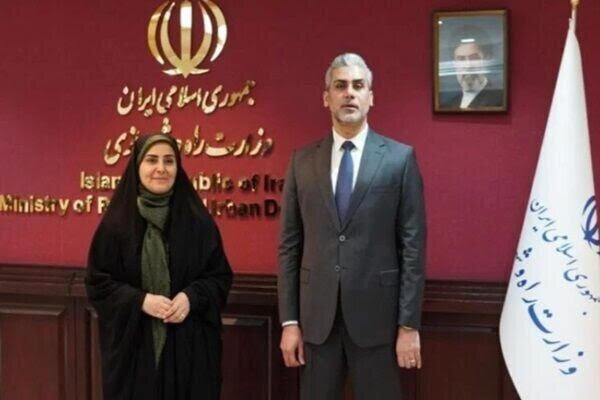
According to IRNA, Farzaneh Sadegh, after meeting Iraq’s ambassador in Tehran, said in an interview, referring to the deep and historical relations between the Islamic Republic of Iran and Iraq: “The relationship between Iran and Iraq is one between two countries with civilization, culture, history, and deep religious commonalities, which has brought the peoples of the two countries closer together.”
Referring to the presence and solidarity of the Iraqi people with the Iranian people on various occasions, she continued: “At the funeral procession of our martyred leader, the Iraqi people showed their solidarity and affection. Also, every year during Arbaeen, we witness the widespread presence of Iranian pilgrims in Iraq, and in return, in holy Mashhad, Iraqi pilgrims make up a significant portion of pilgrims from Iran’s neighboring countries.”
The Minister of Transport and Urban Development stressed: “This connection between the two countries is deep and intertwined, and countries that are far from Iran and Iraq in terms of culture, civilization, ethics, and historical and religious commonalities cannot create discord and separation between the two nations.”
Referring to shared Iran-Iraq issues in the transport sector, she said: “In the field of rail and road communications, as well as the active borders between the two countries, there are many capacities for cooperation, and air communications are also among the important issues between Iran and Iraq.”
Sadegh, referring to maritime capacities between the two countries, said: “There is maritime communication with Iraq and Basra from Khorramshahr port, and in some years, including this year, part of the pilgrims have been transported via the maritime route, and these connections can also be developed.”
The Minister of Transport and Urban Development also referred to her meeting with Iraq’s ambassador in Tehran and stated: “It is very pleasing that Iraq’s ambassador has complete knowledge and mastery of Iranian culture and our country’s structures.”
Referring to joint rail projects between the two countries, she said: “Regarding issues such as the Khosravi–Khanaqin–Baghdad rail route and also the Shalamcheh–Basra railway, we hope the follow-ups will continue seriously and the ground will be prepared for better communications between the two countries.”
Sadegh also referred to road communications between the two countries’ borders and said: “In the road sector, too, there are shared issues between Iran and Iraq that must be followed up and strengthened.”
The Minister of Transport and Urban Development also stated regarding air communications between Iran and Iraq: “The issue of flights was also considered in this meeting, and given the follow-ups being carried out by both countries, we hope the flight problem will be resolved as soon as possible and air communications between Iran and Iraq will improve.
Flights between Iran and Iraq will resume soon
Iraq’s ambassador in Tehran also said: “Today we had the honor of meeting with Iran’s Minister of Transport and Urban Development and reviewing the most important shared topics and a set of fundamental issues that have recently been raised.”
Yasser Abdul Zahra Al-Hajjaj, referring to US pressures on air transport between Iraq and Iran, said: “We are seeking to examine mechanisms, solutions, and initiatives that can help resolve this crisis in the current conditions.”
Referring to the humanitarian and social dimensions of this issue, Iraq’s ambassador said: “Millions of pilgrims travel to the holy shrines, and there are also thousands of students and pupils, a large Iranian and Iraqi community, and extensive trade relations between the two countries.”
Al-Hajjaj emphasized: “A large community of nationals of both countries is present in Iran and Iraq, and economic and people-to-people relations between the two sides are very strong and deep-rooted. I believe such a decision cannot reduce the depth of relations between the two countries.”
He added: “Flights between the two countries will resume soon.”
In early September, The head of the Iran-Iraq Joint Chamber of Commerce, emphasizing the need to create new momentum in the economic relations between the two countries, stated that there is capacity for Iran-Iraq trade to reach $20 billion, and that by resolving some domestic and foreign obstacles, this goal can be achieved.
According to a report by IRNA on Wednesday, Yahya Al-e Es'haq, speaking at a meeting of the Kermanshah Province Export Development Working Group chaired by the governor, referred to regional, global, and domestic conditions and added: "Today, many of our issues in various fields are tied to the economy, and a major part of the solutions for dealing with the current situation must also be pursued in the economic sphere and through practical measures."
The head of the Iran-Iraq Joint Chamber of Commerce, referring to the selection of the title "Pilgrimage and Trade" to introduce the capacities of Kermanshah Province, stated: "Choosing this title can be one of the solutions to some problems, because the potential and actual capacity in this area is very high."
He added: "Kermanshah Province, geographically and in terms of having formal and informal borders, holds a special position and can play a significant role in the development of economic relations between Iran and Iraq."
Al-e Es'haq continued: "In a situation where Iran is facing various issues and threats, utilizing the economic capacities of neighboring countries can be one of the effective solutions for managing the current situation, developing relations, and creating new economic opportunities."
Stating that the goal of increasing Iran-Iraq trade to $20 billion is not just a slogan, he said: "This figure is proposed based on experience and understanding gained from years of activity and examination of the economic relations between the two countries, and I believe that if we resolve some domestic issues and foreign obstacles, it is possible to achieve $20 billion in trade between Iran and Iraq."
The head of the Iran-Iraq Joint Chamber of Commerce, pointing to the capacities of Kermanshah Province, emphasized: "Given its geographical location, border capacities, human resources, and available facilities, Kermanshah has the necessary ability to play an effective role in achieving this goal, and reaching it is feasible."
Al-e Es'haq, stressing that all officials and economic activists are responsible for the development of Iran-Iraq trade, said: "All of us must act upon the advice we give and create new momentum in this area."
He added: "The current situation and the existing trend are not sufficient for achieving the great goals of Iran-Iraq trade, and we must change our methods and approaches to bring about the expected developments."
The head of the Iran-Iraq Joint Chamber of Commerce emphasized: "The Iran-Iraq Chamber considers it its duty to be fully present in this path and will do everything in its power to develop the economic relations between the two countries."
Al-e Es'haq, referring to the presence of figures from Kermanshah in the Iran-Iraq Joint Chamber, said: "Mr. Kashfi and Mr. Sanjabi are capable and influential forces from Kermanshah who are active in this field and, alongside the respected governor, can pursue the province's capacities more effectively."
He added: "If there is determination and demand from the provincial administration and officials of Kermanshah to follow up on issues, the Iran-Iraq Chamber is ready to stand by the province with all its strength."
The head of the Iran-Iraq Joint Chamber of Commerce stated: "It is not that the Iran-Iraq Chamber or other relevant bodies lack the capacity and means to help; there are numerous organizational capacities, facilities, as well as individual and specialized capabilities, and by changing our approach and properly utilizing them, we can resolve some of the existing problems."
At the end, Al-e Es'haq, again thanking the organizers of the meeting, expressed hope that: "With the continuation of these sessions, the creation of new momentum in the economic relations between Iran and Iraq, and close cooperation among officials, chambers of commerce, and economic activists, the groundwork will be laid for the development of trade between the two countries and greater utilization of the capacities of Kermanshah Province."
According to an IRNA report; Kermanshah Province shares a total of over 371 kilometers of common border with Iraq, and along this border, there are two official border crossings and five active border markets, and annually nearly three billion dollars worth of goods are exported abroad through these borders.
MA
source: tehrantimes.com