Southern Lebanese Israel is razing our lives before our eyes
Southern Lebanese: Israel is ‘razing our lives before our eyes'
Day after day, the Israeli-occupied village of Mansouri, perched on a green hill a few kilometres south of the coastal city of Tyre, is slowly disappearing. Already heavily damaged during the war, it is now quite literally being wiped off the map, in a final twist of cynicism, during the ceasefire.
The Israeli army, which has made it one of its main theatres of operations for weeks, is sparing no effort: demolitions with explosives and air strikes have followed one another at a relentless pace in recent days, to the despair of the village’s roughly 5,000 inhabitants.
The village, which the Israeli army presents as an operational stronghold of Hezbollah, was initially located outside the “Yellow Line”, the “security” demarcation imposed by Israel on Lebanese territory shortly after the latest ceasefire came into effect.
Even then, residents Middle East Eye spoke to following the ceasefire feared that the zone would eventually swallow up their village. It now has, although officially only in part: the Yellow Line cuts through Mansouri, dividing it in two.
On paper, that is, as the village is now entirely occupied – this summer, all the residents who had returned to the area had no choice but to flee once again, under fire from the Israeli air force, which continues its operations.
The village mayor has denounced in the local press “attacks against residents using artillery, as well as hand grenades and stun grenades dropped by drones”. He himself miraculously survived after being wounded in an Israeli attack.
My house is the only one still standing
The green road leading to the village of Hanniyeh, still accessible by car to Lebanese civilians, smells of fear.
This tiny village, also perched on a hill outside the Yellow Line, offers an unobstructed view of Mansouri. And, opposite it, of the Israeli troops that have taken up positions on the other side, leaving local residents within firing range.
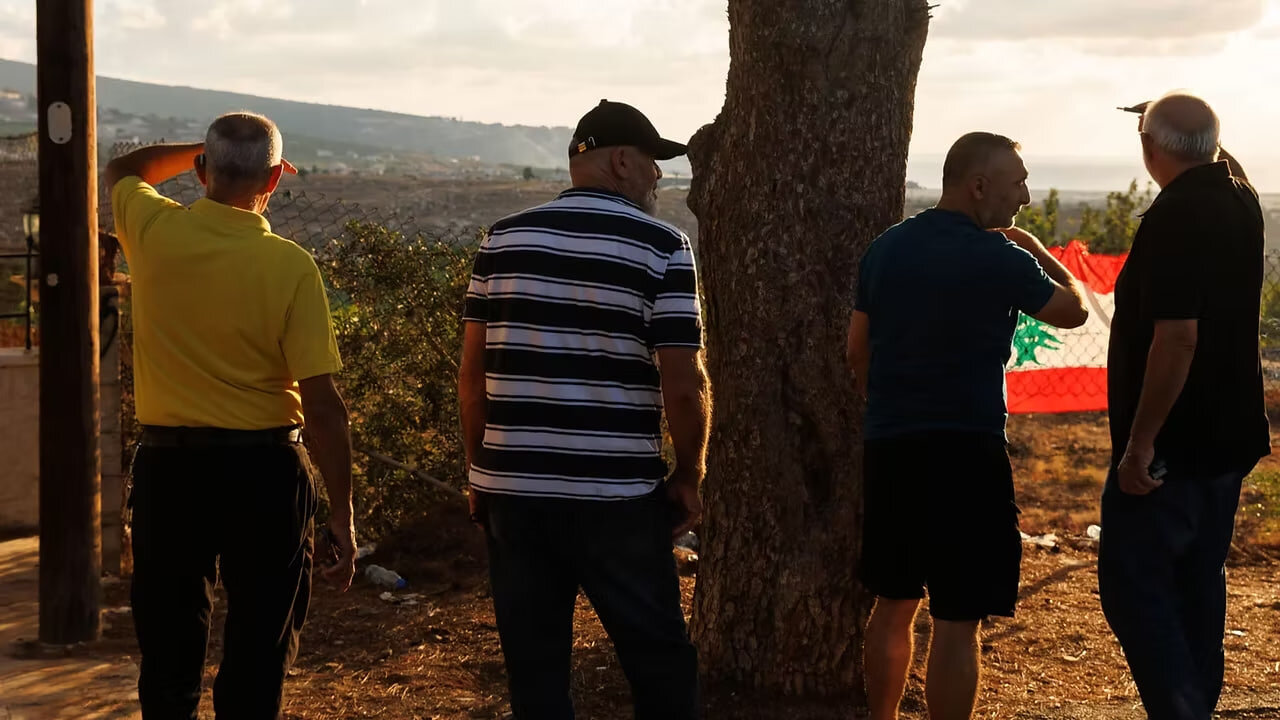
And while most of Hanniyeh's residents have chosen to remain displaced further north, dozens of people from Mansouri pass through the village every day, watching in dismay as the Israeli military destroys their hometown.
On the roadside, hidden behind a tree, Ahmad, 47, has set his phone on a tripod. He is livestreaming on Facebook, trying to document the ongoing destruction for a few dozen viewers.
“Look! The yellow house is mine. It’s the only one still standing; all the others around it have been destroyed,” he tells Middle East Eye.
The scene is chilling, dystopian. He admits it himself: watching his village being destroyed every day while waiting for his own house to be next is profoundly disturbing.
As though the war and Israeli chaos in Lebanon had become a spectacle.
Beside him, Ali, another Mansouri resident whose house was destroyed during the war, says: “Yes, it is humiliating to watch this, but I want to stay here, as close to my village as possible. I don’t want to abandon it.”
He continues: “It’s worse than anything. I no longer have work. I had farmland below the village. Look, smoke is coming from there: they are burning my land.”
Around a hundred metres away, some 30 people, men and women, have set up chairs. Most are neighbours, lifelong friends. Together, they too watch the unspeakable unfold, commenting on the scenes of recent days.
Now without jobs and unable to access their homes, they kill time according to the rhythm of Israeli operations.
One of them shows a video filmed in recent days: an Israeli drone can be seen very slowly lowering explosives, suspended vertically from a cable, and placing them on a rooftop. The images are striking: a few minutes later, the area explodes.
Suddenly, everyone falls silent. A cloud of dust moves along one of the village streets. Israeli vehicles are coming down the road, kicking up dust as they move.
Looking through binoculars, one of the men says he can see a tractor clearing the rubble of a house, which will soon have been reduced to an empty plot of land.
“We haven’t seen any Merkava tanks today. They must be resting,” jokes a man in his sixties.
Ibtissem, a 38-year-old woman, continues: “Every day something happens. One day they bomb, the next they send bulldozers. Sometimes charges they have planted inside our homes explode. It’s torture, they are razing our lives before our eyes.
“But this land is everything to us. We will come back and rebuild, God willing,” she says.
Abandoned by everyone
Unsurprisingly, the inaction of the international community, and above all that of the Lebanese government, comes up again and again in every conversation.
Here, the Lebanese army is nowhere to be seen. Worse still, the residents of Mansouri, like those of the 63 villages located in the area occupied by the Israeli army south of the “Yellow Line” – around 460 square kilometres – say they have been completely left to fend for themselves.
This summer, residents organised a peaceful sit-in near the Lebanese army checkpoint in al-Amiriya, under the slogan “Mansouri is not occupied”, calling for an end to the bombardments and for the Lebanese army to return to the village, and saying they were ready to march alongside it as soon as it decided to enter Mansouri.
“Nothing happened. We and our village were abandoned. And since then, nobody has helped us, absolutely nobody, while we remain displaced and no one has work anymore,” sighs one resident.
Speaking quietly, almost reluctantly, he admits that even Hezbollah, which for years, war after war, helped affected communities, no longer has the means to do much of anything today.
Today, Mansouri, like Tallouseh and Mais al-Jabal further east, is one of the main theatres of Israeli military operations. Many Lebanese see this as an attempt to “finish the job” – in other words, to destroy any possibility of residents returning to the area in order to consolidate Israel’s presence on the ground for the long term.
This dynamic is continuing despite the 26 June framework agreement, which provided for a different arrangement to be tested in the south.
In Froun, Srifa and Zawtar al-Gharbiyeh, three “pilot zones”, the Lebanese army was supposed to gradually regain control on the ground, secure the villages and prevent any unauthorised armed presence there, under the coordination of the Military Coordination Group for Lebanon (MCG4L), the US-led mechanism tasked with overseeing the agreement.
The reality, however, is different.
In Zawtar al-Gharbiyeh, Israeli soldiers were recently accused of opening fire near Lebanese troops as they deployed. On 18 September, in Deir Mimas, an Israeli force approached a Lebanese army position and threw stun grenades in the vicinity, triggering another face-off, defused in extremis through the intervention of the MCG4L.
“We no longer trust anyone to come and help us,” Abbas, a 26-year-old from Hanniyeh, says with tears in his eyes.
“My dream is to get my land back, my neighbours, to rebuild my house. I don’t have much hope left. To have any, the Lebanese army would need to be capable of holding the ground, and as long as the international community does not put pressure on Israel, we may never see our land again.”
source: tehrantimes.com