Tehrans strategic triangle
Tehran’s strategic triangle
Sobh-e-No discusses Iran’s three‑pronged strategy in response to intensified US economic sanctions. The economic siege has entered a new phase, and Tehran is trying to manage the crisis through a triad of negotiation, heightened tension, and economic resistance.
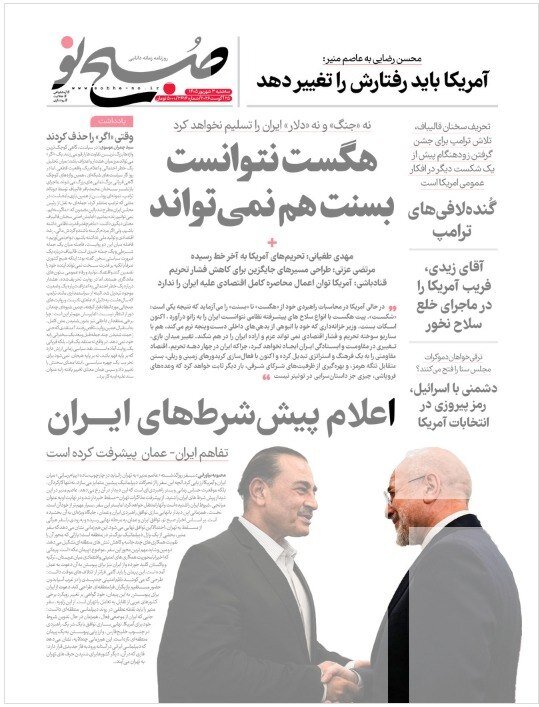
In practice, Tehran has not limited itself to diplomacy and economic resilience; it has also placed security and military options on the table as part of its broader strategic framework. The “Tehran’s Strategic Triangle” requires maintaining defensive readiness, balancing threat and engagement, strengthening regional cooperation, coordinating with Eastern powers, and controlling domestic livelihoods. Overall, in this strategic triangle, military tools are not the first option but serve as a serious backing for diplomacy and economic resistance, enabling Iran to navigate any possible scenario.
Shargh: What is Asim Munir seeking in Tehran?
Shargh writes that the purpose of Asim Munir’s trip to Iran comes at a moment when the regional environment and Tehran–Washington relations are in one of their most complex and exhausting phases. The continuation of the confrontation, combined with the US economic war against Iran and growing pressure on Iran’s domestic economy and livelihoods, has created a picture of a vague and risky horizon. The Pakistani army chief’s visit cannot be interpreted merely as a bilateral meeting or routine military‑political protocol. One possibility is that the trip could help reactivate communication channels and reduce political distance to revive the Islamabad understanding. However, another scenario that should not be ignored is that Islamabad may be carrying tough warning messages from Trump to Tehran, or conveying the concerns of external actors about the direction of current developments.
Jam-e-Jam: Islamic unity and regional security
Jam-e-Jam, quoting former diplomat Mohsen Pak‑Ayeen, analyzes the diplomacy of Islamic unity. This diplomacy aims to strengthen relations with Muslims worldwide and Islamic countries in order to increase commonalities and reduce differences. Given the US and Israeli-imposed war against Iran and the rising need for regional security provided by regional states themselves, conditions for achieving Islamic unity are more favorable than before. Arab and Muslim countries now believe that US military bases and security presence cannot guarantee their security. Instead, Islamic countries must pursue shared regional security through strengthened unity. Such unity could pave the way for a new global order based on multilateralism and resistance to US dominance.
Javan: The UAE’s shadow must be removed from Iran’s foreign trade
Javan analyzes the declining role of the UAE in Iran’s foreign trade. Contrary to some concerns, this decline does not necessarily mean shortages or a halt in imports. Iran can redesign trade routes and import the same goods directly from their source or through alternative pathways. The key point is that Iran’s foreign trade should not depend on the decisions of a single regional hub. Importantly, the replacement strategy should not create a new dependency. The goal is not to find a “second UAE,” but to build a network of multiple routes so that the closure of one path does not disrupt national trade. Thus, removing the UAE’s shadow does not mean cutting trade with it; it means eliminating dependency. The UAE can remain one of Iran’s partners. The current situation is an opportunity to reduce this long‑standing reliance and build trade on multiple routes, partners, and financial mechanisms — a shift that ultimately reduces Iran’s external trade risk.
Hamshahri: The negotiation window is still open
Hamshahri writes that what is emerging between Iran and the US resembles a mix of maximum pressure and forced diplomacy rather than a clear beginning of new negotiations. Washington is increasing the cost of avoiding the negotiating table, while mediators are trying to keep the path toward talks open. The next 24 to 48 hours will be decisive. If Tehran announces readiness to continue negotiations before the full implementation of new sanctions, the hypothesis that Washington is using the “Economic D‑Day” as a negotiation lever will be strengthened. But if the sanctions package is implemented without pause or concessions — and Iran responds by tightening restrictions in the Strait of Hormuz — it will signal that forced diplomacy has failed to bring Tehran and Washington to a point of compromise, pushing the crisis into a new phase of economic‑military escalation.
Siasat-e-Rooz: A performative independence
Siasat-e-Rooz argues that Ukraine’s Independence Day has turned into a symbol of Western dependency. Europe, under the guise of helping, is exploiting Ukraine, while Ukraine itself lost its nuclear and military capabilities by trusting Western promises. In contrast, Iran is described as genuinely independent, relying on indigenous military power and the geostrategic leverage of the Strait of Hormuz. This has enabled Iran to shape a new regional order, whereas Ukraine — despite its sensitive geopolitical position — has become a tool in Western hands and lacks control over the start or end of its own war.
source: tehrantimes.com